

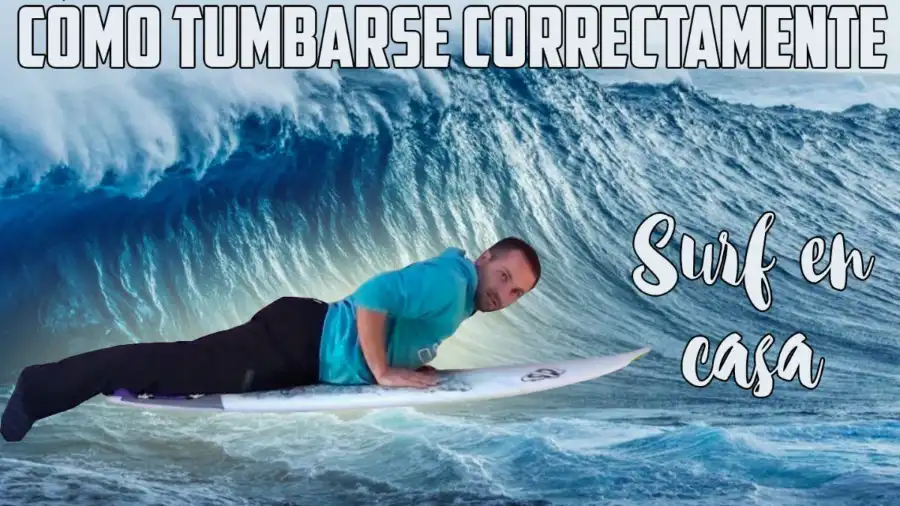
Want to learn how to properly lie on a surfboard? In this video, I’ll show you how to do it and practice at home.
The position lying on the surfboard
The basic key to surfing on a surfboard is moving from a prone position to a standing position. Often, we don’t give enough thought to the correct starting position, creating a series of problems that are very difficult to overcome during the takeoff. Therefore, we have created this video tutorial in the “Surfing at Home” series, in which we will discuss the correct position lying down on the surfboard.
Our body position on the board is directly related to paddling efficiency and the correct execution of the standing technique. To position ourselves on the surfboard, we should not be too far forward on the board, as the nose will dip too far, causing us to fall forward on the board. We also should not be too far back, as the nose and front of the board will protrude too far above the water, preventing us from catching the wave correctly.
Therefore, we must position ourselves as centered as possible so that the board is horizontal on the surface of the water. We must keep in mind that only the tip (roughly a quarter of the board) should be out of the water, which has a slight curvature so that the water breaks against it and we can have greater speed on the wave.
Determine the correct position lying on the surfboard

At Biosurfcamp, we have a series of tricks that allow us to quickly determine how to properly position ourselves on the surfboard:
- Place your knees at the same height as the fins. The position of the fins is a good visual reference point to determine which part of our body goes where. This reference also helps us position our back foot when taking off.
- Touch the tail of the board with the insteps of your feet. A simple way to position yourself on the board is to feel the tail of the board with your feet. This way, knowing the height of your feet will help you quickly position yourself.
- Determine your position out of the water. When you start surfing, it’s a good idea to practice exercises out of the water. This is because the sand is a less unstable surface than the sea and is more comfortable for reference purposes.
- Extend your arms on the board and calculate how far they can reach. Once you’ve determined the correct position on the surfboard, you can extend your arms and use a mark on the board as a reference. This simple trick is very useful, as we visually position our fingertips on a part of the board and memorize the position. It’s recommended to do this trick out of the water and only when using a different size surfboard.
- Get on the side of the board, not the tail. This trick isn’t purely based on the prone position on the board, but it is related to the speed of getting into that position. When taking a beginner’s surfing course, we usually position ourselves in shallow areas, waiting for waves standing up. When getting on the board, at Biosurfcamp we recommend doing it from the side, as it’s faster to get into position than from the tail. This is because if we get on from the back, we have to regain our position with small impulses, whereas if we get on from the side, we can get into position directly.
And then what? Getting up on the board
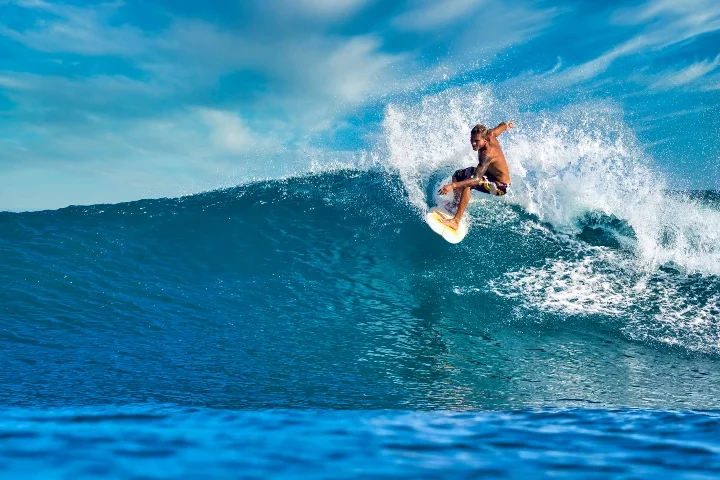
Once we’re positioned correctly on the surfboard, we must move on to surfing. A good lying position on the board is directly related to a good paddling stroke and a proper standing position. To do this, we must visualize the wave we want to ride and begin paddling progressively, gradually increasing in speed, as we saw in our guided paddling tutorial. The paddling stroke is done close to the board, alternating with both arms and controlling everything around us.
When we notice the tail of our surfboard rising, we must perform the standing-up technique we saw in other articles in the series. In short, when we’re lying down, our first ribs should be positioned where the front foot will later be, and our knees should be positioned where the back foot will later be, on the fins. Our hands, once we’ve paddled enough and acquired the desired speed, will also be positioned where the first ribs are, placing our palms flat without holding the edges. With these and your right foot (placing both the toe and heel), you’ll gain momentum to stand up on the board as the wave begins to carry you.
A correct position is when the front foot is in the center of the board or slightly forward, while the back foot is between the two rows of fins, almost at the end of the board. Both feet should be perpendicular to the surfboard, in a balanced position. The body should be tense, semi-flexed, and with your weight forward. Your arms should each be placed on one edge of the board, both facing forward. Your head should be raised and your gaze upward. From this position, you’ll be able to select the best possible option on the wave and enjoy surfing to the fullest.
Do you want to learn how to lie down and stand up with an instructor in the water? Come discover our surf courses in Suances, Cantabria, and enjoy the Bio Surf Camp adventure to the fullest.







0 Comments