

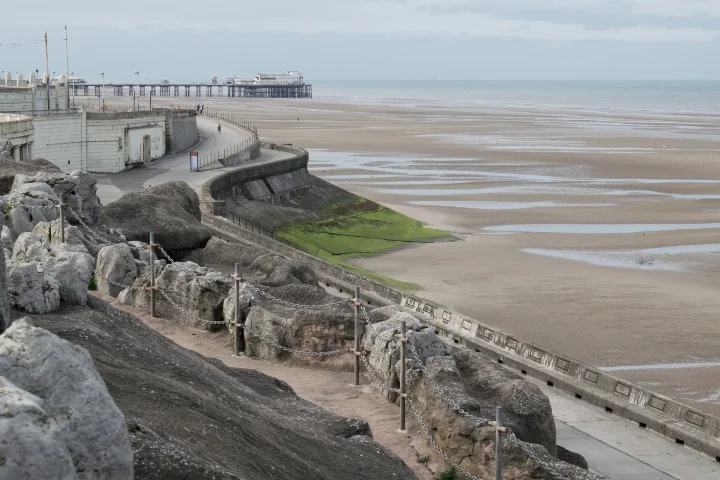
Tides are one of the most fascinating and constant natural phenomena occurring on our planet. Every day, sea level rises and falls in regular cycles that affect beaches, ports, cliffs, and coastal ecosystems. But have you ever wondered why this happens? What force moves these enormous bodies of water across the globe? In this article, we explain what tides are, why they occur, and how the Moon, the Sun, and gravity influence this daily spectacle of nature.
What are tides and why do they occur?
Tides are periodic changes in sea level caused by the gravitational pull of the Sun and the Moon on Earth. This phenomenon involves the movement of enormous masses of water across the surface of our planet, attracted by the stars that surround us. The Moon’s gravitational pull is two to three times greater than that of the Sun, due to the satellite’s proximity.
The origin of tides occurs within the oceans, extending their effect to the coastlines around the Earth and giving rise to the rise and fall of the sea. It is within the oceans where the large masses of water that move due to gravity are found.
“Ebb” refers to the water that rises to the shorelines, and “ebb” refers to the water that descends from the coast and returns to the sea due to the gravitational pull of the Sun, and especially the Moon. Therefore, tides are a continuous ebb and flow of water that constantly reaches and leaves coastal shores. Throughout the day, there are two high tides and two low tides, meaning two flows of water to the coast and two ebbs of water back into the sea. Therefore, the ebb and flow of water is the main driver of the tides.
Newton, gravity and the science of tides
The basis of the tides is explained by Newton’s laws. The force of gravity is the cornerstone of the law of gravitational attraction of the Sun and Moon to the Earth. Newton stated that the attraction between two bodies was directly proportional to their masses and inversely proportional to the square of the distance between the bodies.
In other words, the attraction is greater the greater the mass and the smaller the distance between the objects. The Moon describes an elliptical orbit around us, just as we describe an elliptical orbit around the Sun. In the case of the Moon, the side of the Earth facing the Moon has a greater attraction, being closer to the satellite, attracting large bodies of water and producing high tide. Meanwhile, on the opposite side, due to the centrifugal force of the Earth relative to the Moon, a high tide (of lower intensity) occurs.
It should be noted that in Newton’s formula, distance weighs more than the mass of bodies; therefore, the Moon’s gravitational force is two to three times greater than that of the Sun, despite the star’s size. Therefore, lunar tides are more powerful than solar tides.
High tides and low tides
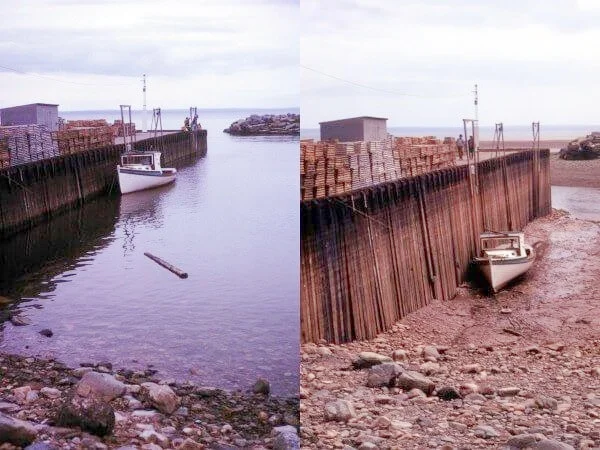
High tide is the moment when the sea reaches its highest point. There are two high tides per day, 12 hours and 25 minutes apart. Low tide is the moment when the sea reaches its lowest point. Similarly, there are two low tides per day, 12 hours and 25 minutes apart. The tidal half-period (the time between high and low tide) lasts 6 hours, 12 minutes, and 30 seconds, so the tide changes by about 50 minutes daily.
Surf schools use this reference (about 45-50 minutes) to schedule surf lessons for the following day. This is done this way because all beaches have an optimal tidal point for surfing. For example, it is important for divers to know when high tide occurs and the “ebb” of the water begins, as the force of the sea can pull them into the ocean. Therefore, it’s advisable to dive at low tide. Low tide is also the perfect time for many fishermen to go fishing, especially during spring tides.
Spring tides and neap tides
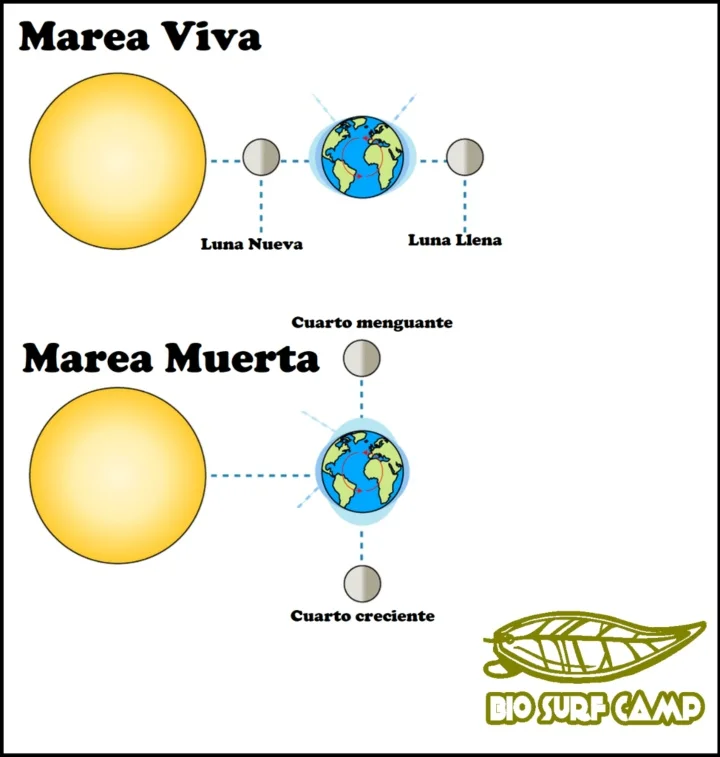
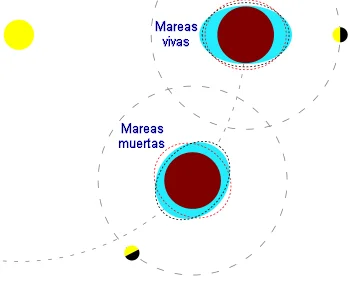
Spring tides are a type of tide that occurs during the full or new moon. These tides are the greatest distance between high tide and low tide. This great distance is due to the alignment of the Sun and Moon, which produces a greater gravitational pull. On these occasions, it is interesting to take a trip to the intertidal zone to see the diversity of flora and fauna found in the sea.
Neap tides are a type of tide that occurs during the lunar quarters (the last quarter and the first quarter). These tides are the shortest distance between high tide and low tide. This minimum distance is due to the fact that the Sun and Moon are at opposite points, forming a 90° angle, offsetting their forces of attraction.
One of the places where there is the greatest variation between high and low tide during spring tides is along the coast of the Bay of Fundy in Canada. On this coast of the Atlantic Ocean, a variation of almost 20 meters can occur. On the other hand, small seas like the Mediterranean Sea have almost no tides, with a very short distance between high and low tide. This is due to the small amount of water moving, which does not affect sea level on the coast. Another place where tides are almost imperceptible is along the Equator. This is because this is where the centrifugal force of the Earth’s rotation is strongest, resulting in higher sea levels.











0 Comments