We love what we do, we’re clear about it, and we want to share it with people who appreciate an original and unique project. How can we define what makes us a special surf camp? Perhaps the three letters BIO can encompass a good part of our concerns and philosophy. We’ve summarized it in the following points:
35 Actions we take that help the planet
- Renewable electricity—solar panels: We recently installed 20 photovoltaic solar panels, which produce a significant portion of the energy the camp consumes during the day. The pollution produced by the camp’s activities is greatly reduced, given that almost 80% of the electricity consumed in Spain comes from fossil fuels, including uranium.
- Use of 4Eco cleaning products with short degradation periods in the environment, 100% domestic production, and a bulk distribution system that avoids the generation of packaging and the consumption of plastics. We have been cleaning our facilities with this brand’s products for three years, and with your stay you support this collaborative company, which has many points of sale throughout the Iberian Peninsula. Find the nearest one if you are interested in using them for your home. It is a great reference in the sector and just like we like, a small business run by people like you who love to care for the environment.
- Breakfast with various organic products such as flour for breads and cakes, muesli, herbal teas, lemons for cakes and oil, fresh homemade oat milk, lemonade, and freshly squeezed citrus fruits, many of them from our own production. We would also like to highlight the cereals we purchase from the nearby organic producer Pablo García Plaza, who is involved in a very interesting project of producer-consumer trust. The oil is probably produced in the most environmentally friendly olive grove in the world, Llanos de Vanda, using organic farming methods that promote biodiversity conservation. A unique, extinct species has just been discovered, present only in this small refuge for birds, plants, and other auxiliary fauna. It has been managed very differently for several generations than in the rest of Andalusia’s olive groves, including a large part of the organic olive groves. We visited the area in spring, and it is a complete contrast to see the mountain ranges arranged like a striped sweater, with every plant species eliminated from the olive grove and the land tremendously eroded and impoverished by the lack of organic matter. In contrast, the sea of flowers and countless species that carpet the Cándido and Ángela olive groves.
- Recycling the waste we generate. In addition to traditional waste separation, we separate organic waste that can be used by the chickens, such as leftover pasta, rice, fruit peelings, etc., and all leftovers except meat and fish can be composted for the garden. This way, we reuse a large amount of waste that doesn’t end up in the garbage collection system at its source.
- DIY: All the installations you see were made by us with our own hands and DIY tools. This has avoided countless purchases of materials from distant sources and the many miles of transportation and manufacturing that travel from the source to the countries of production and then to the countries of sale, crossing several continents along the way. We have built the bungalows, bathrooms, and kitchen to fit the available space using wood from Cantabria purchased from our friend Gerardo Madero of Maderas Cartes. You can also see many repurposed items, such as recycled pallet sofas, recycled wooden tables on the beach, and a multitude of chairs and small tables we restored.
- Green constructions: While our generation has experienced an unprecedented urban boom in brick and mortar, here you mainly find buildings made of wood, bamboo, hazel, Cantabrian pine, and low-impact, breathable fabrics. Green roofs maintain environmental functions, such as capturing CO2 from the air. Or passive solar planning, with large windows and an integrated greenhouse that lets the sun’s warmth in during the winter. We love working with the bamboo we collect from the Pas and Miera rivers, where it has become invasive and is displacing native riverside species.
- We make fresh homemade breakfast products, such as bread and cake, that we prepare ourselves, avoiding a multitude of packaging and undesirable products such as pre-cooked foods, preservatives, and flavorings found in the food industry.
- A handcrafted windmill built by us to raise awareness of domestic alternatives to energy needs. You can see our windmill, built by ourselves from a car axle and crafted with wood, resin, copper, and iron. It is a Hugh Pigot model for 750 watts of power.
- A well is used for irrigation and channeling to the natural pond, and water is collected from the roof for rinsing suits.
- An organic permaculture garden with crop rotation in groups of plant families, so that each species is replanted in the same location only after four years to allow the soil to recover. We also do not use herbicides, pesticides, or other chemicals that are toxic to health.
- We generate compost and reuse organic waste: We have developed a soil enrichment method using compost from leftover meals processed by California worms, composted grass from the Biosurfcamp harvest, and chicken manure from our chickens. This way, we avoid having to add chemicals such as fertilizers.
- Solar cooker: We have installed a solar cooker as an alternative to gas or electric stoves, offering a new and fun way to cook directly thanks to the sun that accompanies us in the summer.
- Used oil recovery: We recycle and reuse the used oil generated at the camp. We have a pressure or drop filtration system that purifies the oil before giving it a second life as soap or biofuel.
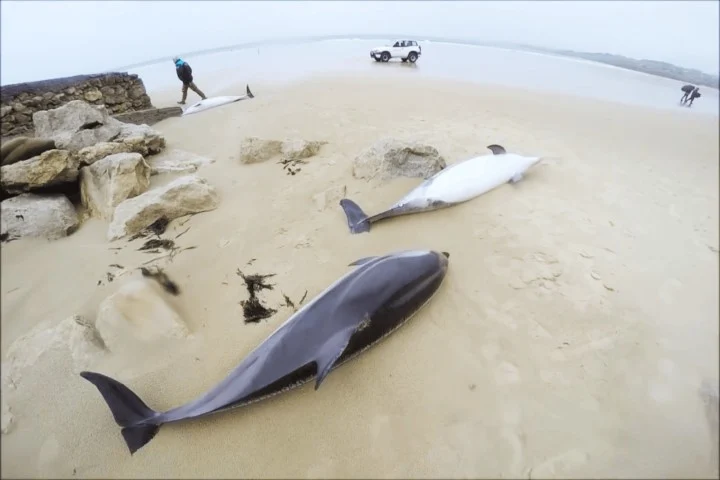
- Plastic and waste collection on the beach: the actions of a few can change the fate of many, so we always take a bucket to the beach. In addition to storing some essential items for the course, we also collect any waste that appears along our path and that we want to prevent from returning to the sea and causing further damage. Aside from visual pollution of the beach, plastics were the cause of the death of a whale that stranded in neighboring San Vicente de la Barquera a few years ago, bags appear in the stomachs of some dead turtles, the remains of fishing nets are dangerous when we are surfing, as are the most diverse things we have pulled from the sea.
- Dry bathing: Rivers are polluted by excess organic matter, mainly from urban waters, and the decrease in their flow due to the same cause. Meanwhile, soils are desertifying and losing the appropriate proportion of organic matter at a continuous rate. To offer an alternative to both realities, we offer a dry toilet that works without consuming water, without generating gray water, and allows us to compost an organic fertilizer suitable for hedges and fruit trees every four years. After each use, it is covered with sawdust or lime to prevent odors and maintain hygiene.
- Using our own wood: We have a hundred trees, in addition to a multitude of fruit trees and protection from the strong westerly winds. They require pruning every two or three years, from which we obtain a quantity of wood to heat our reception area and home, thus avoiding the use of heating and the consumption of gas or diesel.
- Small-scale Fair Trade: Local textile production is currently not viable for us at a low or moderate price, so we outsource production to our friend Rajendra, who uses his small workshop and sewing machine in Kathmandu. He sets the price for the t-shirts and sweatshirts he embroiders himself. In a world where textiles cannot be produced in Europe without multiplying their costs, we have found an alternative that suits us: direct, without intermediaries, where we know the profit goes to those who work with our garments.
- Offering our own products: We offer our customers products such as lemons, bay leaves, mint leaves for infusions, hibiscus flowers, calendula flowers, and rosemary for barbecues, elderflowers and berries for cooking, and fruits such as loquats in June, persimmons in September, and kiwis in October as they ripen.
- Aloe vera cultivation: We also have an aloe vera cultivation for those who need it, which can be tested directly on the skin and used to heal sunburns or hot oil burns, as well as for applying to the body after opening pores in a hot sauna.
- We reclaim wood from the beach for fuel and for the tables, trunks, and bases of the bungalows. Send surf camp under the highest hedges that protect us from the west wind we have stored a lot of wood that we have been bringing from the beach different winters in which the river brings very large quantities of tree branches etc. We go to the beach with the wheelbarrow the axe and the chainsaw and we collect all the fuel we need for the winter and not depend on fossil fuels. On the other hand, on one occasion, 8 years ago, a giant log arrived, probably from a ship that was bringing wood from tropical Africa. It was in the crazy ones for several months and it was a problem if it returned to the sea and collided, for example, with a boat, there was no way to get that log out of there, so we called our friend from El Bierzo with his invention, the portable sawmill, and right there, on a beautiful winter weekend, we dismantled that giant log into 30 planks, 15 for our friend Olegario and 15 for us. With them, we have carried out numerous jobs at the Camp, such as the wooden bases of the four bungalows, the workshop workbench, two trunks, and three breakfast tables, all having reused wood lost at sea and stranded on La Concha beach.
- Green building and green roofs. We have lived in a time of enormous urban growth, based mainly on brick and cement. We have taken a bet on other types of predominant materials and different designs, proof of this is the yurt that we built 10 years ago with materials from the area. We collect hazelnuts in the nearby mountains and bamboo in the areas of the Saja rivers and look at how they suffer the intrusion of bamboo as an invasive species. Our small action of trying to control the expansion of bamboo is to collect it both for the construction of the yurt and two showers and a multitude of other uses. Both the yurt and the dome bedroom have been built by us with nearby wood as green roofs. Currently, there are two green roofs, the type in the workshop and in the kitchen where grass and ferns grow and fix carbon dioxide from the atmosphere while receiving the sun’s rays and tempering the environment. Also, the four bungalows have an adaptation of the hedge to provide shade, making a natural thermal island to protect it from direct sun and thus allowing plant growth where a normal roof would not. We allow other species such as The kiwi is producing large bunches of kiwis on the roof of the yurt, or the persimmon on the roof of bungalow 4, or the palm tree can grow on the roof of the dome. This way, we can transform the typical roofs that reflect the sun’s heat into green roofs that absorb that heat and temper the environment, like a small grain of sand in our fight against climate change.
- Low-consumption infrared sauna, solar thermal energy, aromatics. Within our means, we have opted for a sauna with low-consumption infrared panels, meaning our sauna consumes about half the energy of a traditional electric sauna.
- Medicinal plants. Another Surf Camp initiative is to integrate medicinal and healing plants into the environment. You can see several plants famous for their therapeutic applications, such as aloe vera, although we grow about 40 plants, as well as other lesser-known plants, such as elderberry, fennel, chamomile, comfrey, lemon tree, and castor oil.
- Energy contracted with the Solabria renewable energy cooperative. We support the consumption of renewable energy by being members of the Cantabrian cooperative Solabria, which sells only renewable energy packages. We support the work of this cooperative, which is currently in its second phase, installing solar panels to produce the energy they sell themselves. Small-scale production from collaborative entities like this cooperative share our philosophy, and we encourage anyone to join or find a similar one in their community for domestic consumption.
- Wetsuit, board, and leash repair. We try to get the most out of the equipment possible, ensuring it’s always in the best condition, but sometimes a small repair can prevent a board, leash, or wetsuit from being thrown away, thereby reducing the consumption of the materials that allow us to develop and enjoy surfing. When they have reached the end of their useful life with us, we try to sell them at a fairly affordable price so that some of our visitors and others can take home equipment that can still be used perfectly for surfing, even if it no longer looks like new.
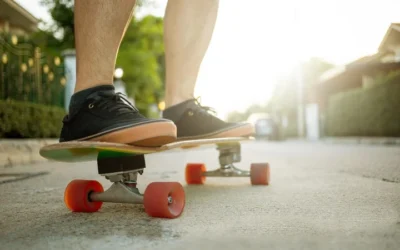
- Bikes, surfskates, skates for sustainable mobility. We have a group of surf skate bikes to facilitate mobility to nearby points in the city center and the beaches without having to overuse vehicles.
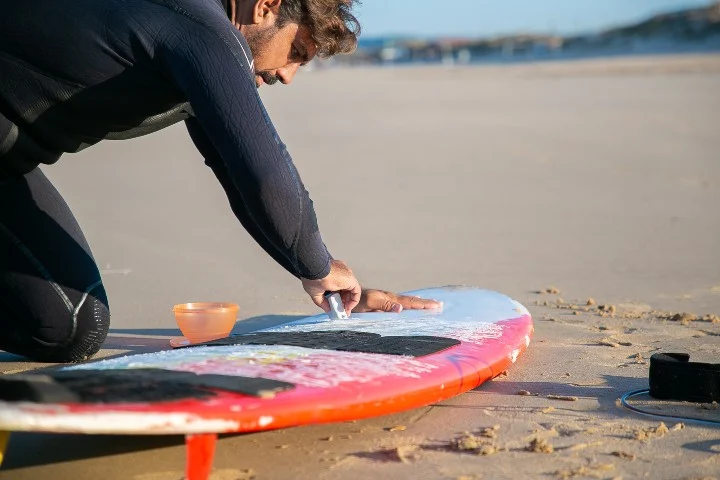
- Greenfix and Caloca paraffin boxes. We have opted to use 100% biodegradable paraffins made from natural products such as pine wax and resin. This ensures that the sea can degrade the paraffin quickly, as the paraffin dissolves or is lost in the boards and falls into the water. We have these paraffins for sale for anyone who wants to write them. We emphasize the high quality of the Caloca paraffin produced by a surfer from Los Locos in the neighboring town of Santillana del Mar using local products from Cantabria.
- Outdoor facilities. Surf school. We have also opted for open facilities that do not require bricks and roofs, which are unnecessary for us. Our premises, which house all the surfing equipment such as boards, wetsuits, inventions, buckets, etc., are protected but open to the air. Free, without a doubt, is much more hygienic for wetsuits and extends the climb. The great ventilation from the outside, which you can’t get in a closed space, is what we built the wetsuit closet with nearby pine trees and bamboo collected from rivers.
- Soul Surfer organic sunscreen for surfers. We have a completely bio-natural and effective sunscreen option for the summer sun. We support our friend Estefi with her Soul Surfer project and have been making her sunscreens available to people for two years.
- Facilities integrated into the landscape. We try not to be a burden on the landscape. Most of the residents of Suances don’t even notice that the facilities are crowded in the summer, and there is no economic activity except for the cars parked outside. When we invite a neighbor to BIOS Surfcamp, they are usually very surprised to learn that they have been passing by there for 20 years and have not realized everything that is inside. This is our greatest proof that we have managed to integrate Biosurfcampcom. The person who goes out to enjoy one of the central green areas of the town remains the same as always.
- A surf company that cares for the coast and the dunes. The entire tourism industry, and especially the surf industry, has to establish itself on the beachfront, usually on top of what have been the most fragile ecosystems in the entire European Union: the dunes. We can proudly say that we are one of the few schools that do not represent an additional burden on the fragile lunar and coastal ecosystems. We have chosen to come closer to the beach every day and to establish ourselves close by, but in a different ecosystem where there is much less human pressure, which at the same time gives us the opportunity to enjoy the tranquility of nature.
- Bird refuges, open land, grassland and constant water, a multitude of trees, hedges, and walls that provide nighttime shelter, many animals, and ideal places to make their nests and raise their young. You can find a multitude of nests, both among blackbirds in the hedges, among goldfinches in the fruit trees, among Chinese trees in the walls, and among hedgehogs in cavities dug in the ground. In an area primarily comprised of meadows and abandoned pastures, Bio Surf Camp stands out for its biodiversity and variety of plants, hedges, and trees that provide shelter for a multitude of species and generate greater biodiversity throughout the area known as Redondela las Huertas.
- Using ethical banking is another initiative we’ve taken: opening an account at an ethical bank like Triodos Bank. We also operate with conventional banking, but we transfer the majority of the funds to an ethical bank to ensure that the money from the Bio Surf Camp project isn’t used for projects that harm the environment.
- We support and disseminate the Wave Protection Manifesto to continue expanding this unstoppable wave of surfing countries and communities demanding the protection of their most extraordinary breaks. Four reserves have already been declared in Cantabria, and the initiative launched by our neighbor Juanjo and his organization Surf-nature Alliance, based in Torrelavega, has already crossed the seas.
- We support the commitment of other surf schools in our community by actively collaborating on a project for responsible surf school management and the protection of our surfing environment: the ocean and the beach.




0 Comments