

It’s quite common to want to buy a surfboard with a “pro surfer” shape — that is, a shortboard that’s small, thin, and light. Maybe it comes from the desire to have the same gear as the surfers we admire. But choosing a board that’s too small and lacks buoyancy, especially for someone who hasn’t yet mastered paddling technique or board posture, isn’t really the best option.
At my local beach, Los Locos in Cantabria, it was a classic scene in the ’90s: after the world championships in Zarautz and Hossegor, several intermediate surfers would show up with boards bought from the pros — proud to feel a step closer to surfing professionally. I used to look at them with admiration, but nowadays I think most of them didn’t make the right choice. They were far from needing such light, low-volume boards with very little thickness.
Choosing the right size for your surfboard — especially when you don’t have clear references — can seriously slow down your learning, lead to frustration, make you feel stuck, or even cause you to give up before reaching your full potential.
We often have a very fixed image in our minds of what a surfer and their board should look like. But an honest, objective look at your current physical condition, your technique, and your realistic short-term goals will be your best allies when it comes to making a smart decision — one that helps you progress steadily until you’re ready for different dimensions, maybe more in line with that image you had in mind.
At Biosurfcamp, we have a wide range of boards for all levels and types of surfers — from foam boards and epoxy funboards to shortboards and stand-up paddleboards. During your stay at the camp, or through our equipment rental service, you can try out different types of boards and find the one that best fits your needs — without having to buy a new one. Just one surf session with your future board can save you a lot of time and effort that a poor choice would cost you.
The world of surfing is huge, with many types of surfers — and that’s exactly why there’s such a wide variety of boards on the market. The key principle to remember is this:
“Choosing a surfboard depends first on your weight and height, and secondly on your technique, physical condition, the kind of surfing you want to do, and the type of wave you want to ride.”
How to Measure a Surfboard
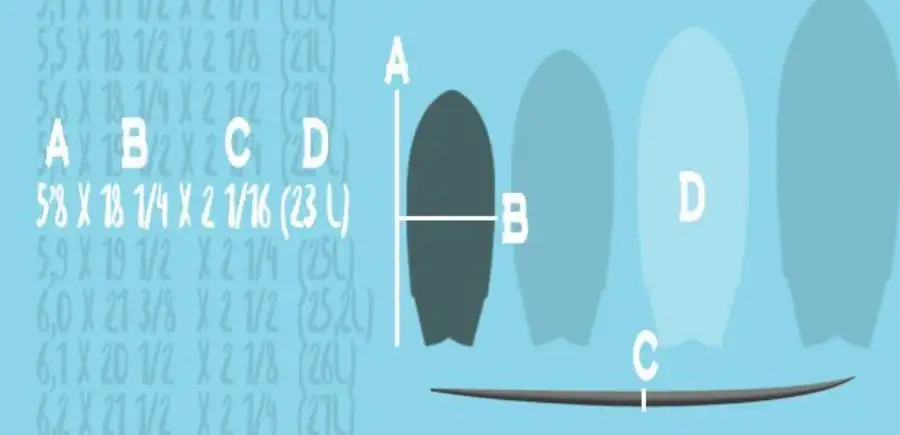
A = Height or Length
B = Width
C = Thickness
D = Volume
Where can we see this on a surfboard? Usually, on the back of the board, written in pencil on the stringer (the wooden strip that runs down the middle of the board).
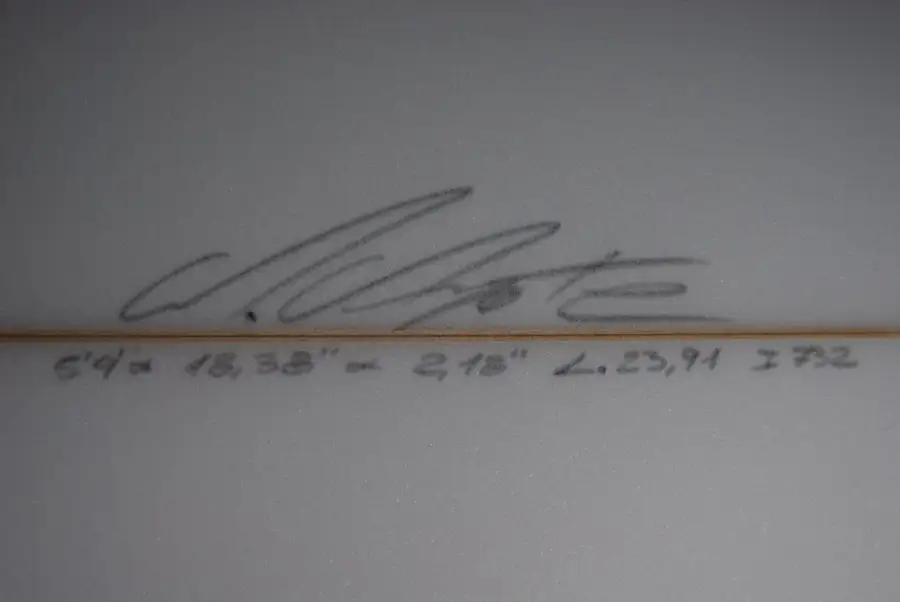
In this case, the shaper or designer of this board is Mikel Agote, as his signature appears next to the measurements.
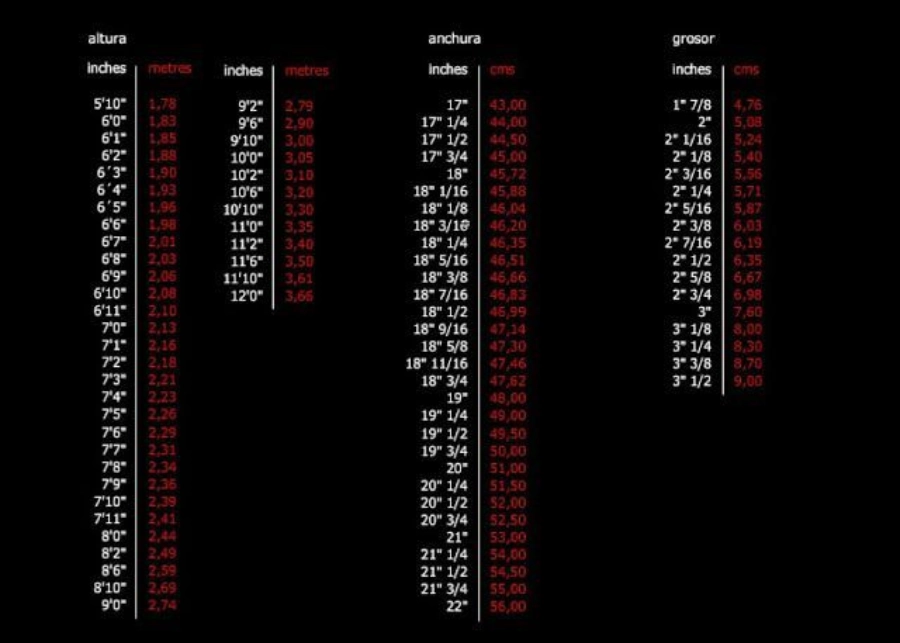
Surfboards are usually measured in feet and inches:
1 inch = 2.54 cm
1 foot = 12 inches = 30.48 cm

The size of our surfboard would be:
- 23.91 liters in volume
- 5 feet 9 inches or 175.26 cm in length
- 18.38 inches or 46.68 cm in width
- 2.18 inches or 5.53 cm in thickness
Recommendations for Choosing a Surfboard
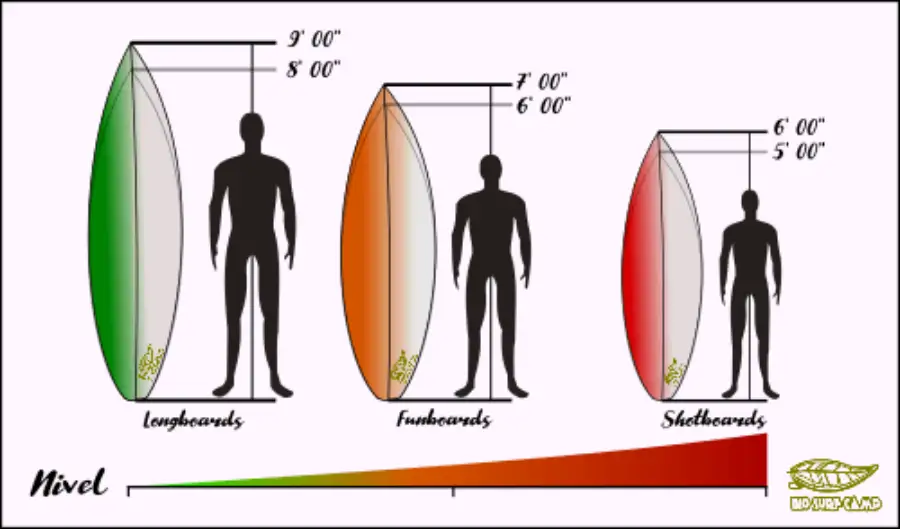
According to the board’s length:
The length of a surfboard is the distance from the tail to the nose. The longer the board, the easier it is to paddle and catch waves.
From 7.0 to 9.0 (Funboards or longboards): for all types of surfers or those over 1.70 m who have a heavier build.
From 5.0 to 6.0 (Shortboards): for experienced surfers between 1.50 m and 1.70 m tall.
From 6.0 to 7.0 (Shortboards, funboards): for experienced surfers over 1.70 m tall.
According to the board’s width:
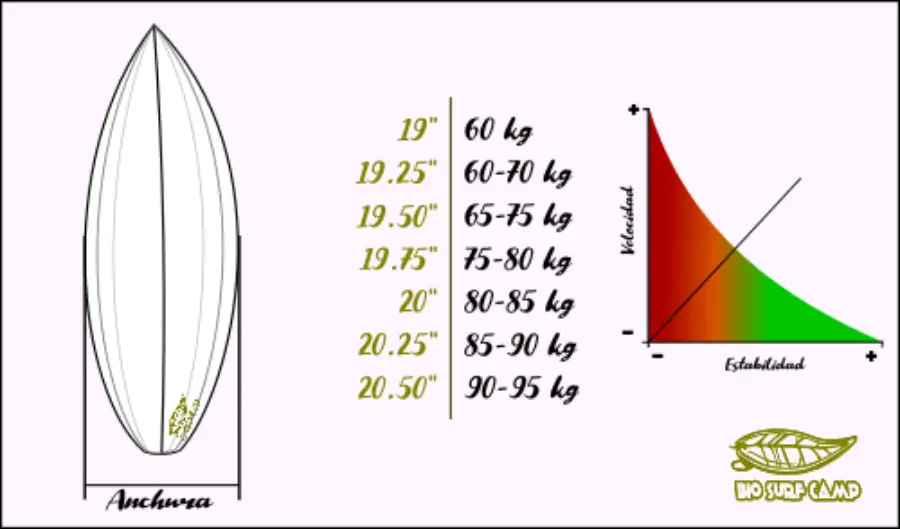
Width is the distance between both sides of the board at its center point. As the width increases, so does stability; as the width decreases, speed and maneuverability improve.
20.50 inches for people between 90 kg and 95 kg
19 inches for people weighing around 60 kg
19.25 inches for people between 60 kg and 70 kg
19.50 inches for people between 70 kg and 75 kg
19.75 inches for people between 75 kg and 80 kg
20 inches for people between 80 kg and 85 kg
20.25 inches for people between 85 kg and 90 kg
According to the board’s thickness:
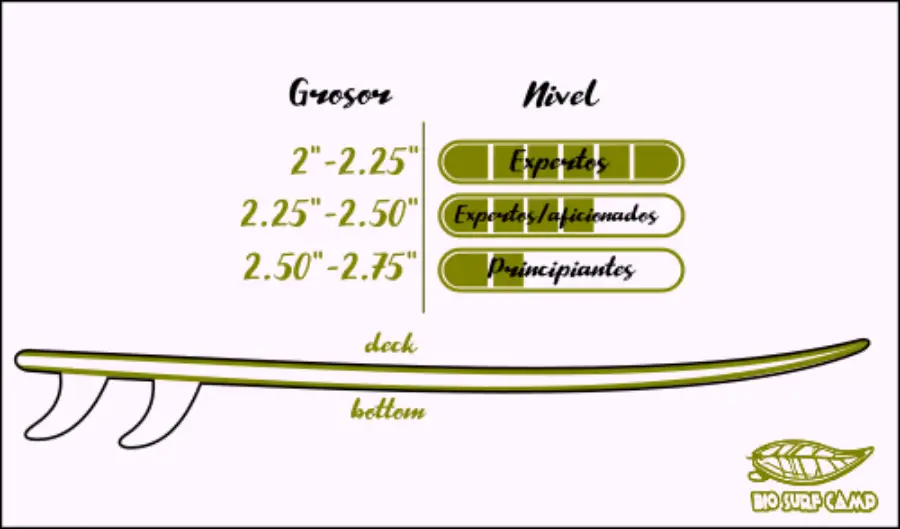
The thickness of a surfboard is the distance between the bottom and the deck at the thickest point of the board, which is usually located near the middle. It’s important to note that the thickness decreases as you move toward the nose and tail of the board.
Between 2 1/2″ and 3″ for all types of surfers looking for stability and easier paddling.
Between 2″ and 2 1/4″ for experienced surfers looking for high maneuverability.
Between 2 1/4″ and 2 1/2″ for experienced and intermediate surfers who want to turn and perform certain maneuvers.
According to the board’s volume:
Volume is a relatively new reference that surfboard brands have started using recently, but it’s key to knowing which board will give you comfortable floatation. Volume is calculated by multiplying the board’s length, width, and thickness. By knowing the volume, you can adjust the other dimensions and still feel comfortable with how your board floats in the water. For example, if you surf on a 5’9” × 18.38” × 2.18” board (around 25 liters), you’ll likely also feel good riding a 5’7” × 20 1/4 × 2 1/2 board (also 25 liters), because they have the same volume.
Generally, the more skilled you are in the water, the fewer liters you’ll need. If you’re in great shape and have a high level of surfing, having less floatation may help you perform better maneuvers. But if you’re just starting out, volume will be your best friend.
In the end, volume is the most important measurement on a surfboard, as it combines all the other variables into one. To give you an idea, here’s a rough volume guide:
17 to 20 liters: shortboard for experts or children
20 to 24 liters: shortboard for experts or preteens
24 to 27 liters: shortboard for expert or intermediate surfers
27 to 30 liters: shortboard or funboard for expert or intermediate surfers
30 to 33 liters: shortboard or funboard for expert or intermediate surfers
36 to 39 liters: shortboard or funboard for expert or intermediate surfers
More than 40 liters: funboards or longboards for all surfers. Boards over 40 liters are used in our beginner surf courses.
Important Factors When Choosing the Dimensions of Your Surfboard
Age
This is a very important factor. Children may need a softboard to start having fun and gradually move on to lighter boards. Teenagers who are still light need smaller boards for the following reasons:
If the board is too big, they won’t be able to handle it properly in the water, and they won’t be able to duck dive due to their size. Plus, they don’t need that much buoyancy. It’s common for small kids, with lighter bodies, to be able to perform aerial maneuvers that become harder for adults.
Older people may need larger boards to paddle more easily and catch more waves without excessive fatigue. The advantage of larger boards is that they float more and their dimensions increase speed. On the other hand, you lose some maneuverability when turning.
This isn’t a universal rule. There are people in their 40s and 50s who surf with a radical and stylish approach, just as there are younger surfers with a more conservative style who use very high-volume boards.
And there’s no need to worry about switching from a shortboard to a longboard — the local surf legends do it and still surf like the best. In fact, large boards allow for a wide range of longboard tricks.
Weight
The more you weigh, the wider and thicker your surfboard should be to float properly — it’s a matter of physics. Weight is a key factor in ensuring a surfboard floats. Foam school boards provide great buoyancy so that beginners can lie down fully without sinking.
We should also remember that when we’re moving in the water, the board’s buoyancy increases, allowing us to stay afloat even on lower-volume boards. That’s because our full “dead” weight isn’t on the board — we use the motion to stay balanced.
Height
As a general rule, the taller you are, the longer your board should be. For beginners, it’s essential that their board is taller than they are.
If you’re 5 feet tall, a board from 7 feet and up will be tall enough so the nose doesn’t sink when paddling. As you gain experience, the board size can start to decrease.
An experienced surfer, on the other hand, may choose a board shorter than their own height to benefit from greater maneuverability in turns and tricks. Ultimately, height plays a key role in paddling comfort, as maintaining a good prone position is essential for popping up efficiently.
The Waves You’ll Be Surfing
If you live in a place where the waves are usually small, a longboard will be the better choice. It’ll help you catch more waves and surf with less effort. A bigger board means more push from the wave and easier rides.
If the waves are medium, big, or hollow, you’ll need to consider what size and shape of board best suits those conditions and your needs. Here’s where the surfer’s goals come in.
If you’re just starting out, a longer board will make things more fun and help you improve without frustration. If you’re an intermediate surfer, a shorter board will help sharpen your technique and increase your skill level.
For very big waves, you might need a long and narrow board to get the speed needed to stand up quickly and avoid steep drops. That’s why expert big wave surfers, like those riding La Vaca XXL in Cantabria, use longer boards for better stability.
How Often You Surf
If you spend a lot of time in the water, you can go for a slightly smaller board than what’s recommended. It’ll save you money and help you skip the constant buying and selling of boards.
As you progress, you’ll gradually feel comfortable with smaller boards.
If you only surf occasionally — once or twice a month — a thick, long board close to a longboard is best. You won’t improve quickly, and you won’t need another board anytime soon. If you surf occasionally, you’re mostly looking for fun and to catch as many waves as possible — so a bigger board is your best choice.
In Summary:
If a surfer knows their body weight and height, and also considers their skill level and the type of waves they’ll surf, they can estimate their ideal volume fairly well.
If you know the volume of your favorite board, that number can guide you when choosing your next surfboard. And if you’re not sure, you can always ask an experienced surfer or a surf instructor for advice.
These tips for choosing the right surfboard size aren’t a magic formula and won’t work miracles — we’re all different — but they can be a useful reference in your search for the perfect surfboard dimensions.
Leave us a comment and we’ll get back to you — or share what helped you choose your board!










0 Comments