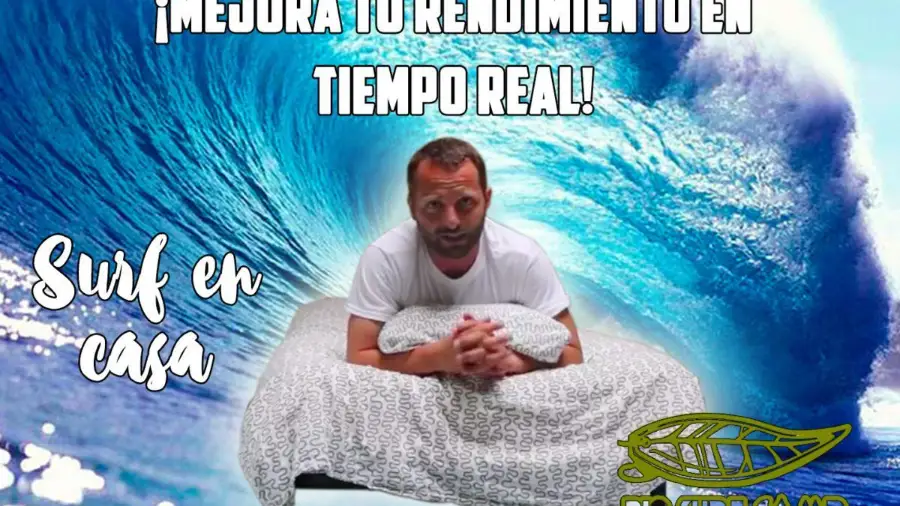
In this video tutorial from the “Surf at Home” series, we’ll practice five exercises over 10 minutes to improve our paddling performance in surfing or, if you’re a beginner, learn the basic paddling movements before your first time in the ocean. It’s the perfect preparation for your first surf courses. At Biosurfcamp, we aim to share our experience and surfing techniques so all our students can reach their full potential.
This video is a guided surf tutorial, so for better learning, we recommend doing the movements along with Pablo Ruiz, the director of our surf school in Suances, Cantabria. The tutorial includes 5 exercises to be performed consecutively for 2 minutes each. The best approach is to do these exercises in the days leading up to your first surf experience.
With these surf movements, you’ll improve your technique, strength, and skill when paddling waves. Knowing that not everyone has access to surfing equipment at home, we’ve created this functional training where all you need is a bed, a pillow or cushion, and, above all, the motivation to learn and improve your surfing.
First, place the pillow in the middle of the bed to simulate the surfboard, while the mattress represents the ocean water. This setup creates a space between “the board” and “the sea,” just like in real surfing. Also, the soft mattress surface provides some instability, helping you feel like you’re on the water.

Next, we’ll explain how to perform each of the 5 movements:
- For the first paddling technique, lie down on the pillow and start paddling, pressing your hands and arms against the mattress and pulling back. The movement should be strong throughout the entire arm stroke. The paddle stroke should be wide, from the front all the way back, to move more water. You need to exert enough force so that your chest lifts slightly off the board. It’s very important to keep your back straight at all times and maintain power in the paddle. This way, you’ll reach higher speed to catch the waves. This is the most basic paddle stroke for catching a wave while surfing.
- In the second paddling exercise, keep your back straight and look around to control the sides. This way, you can see how the wave is evolving in its final moments, whether it’s a right or a left, and if other surfers are already catching it, helping you avoid accidents and collisions. This action is similar to checking the rearview mirrors in a car. It’s one of the most important gestures on a surfboard, as it lets you check the wave’s priority, locate the peak, and orient your board.
- For the third paddling exercise, keep your spine straight but bring your body closer to the board with your face looking down. In this position, paddle with more power to reach higher speed. This is a position you’ll use once you’re well positioned on the wave and need an extra boost to catch it. It’s very important to only use this paddle stroke when you’re sure no one is nearby, as your vision is reduced because you’re focusing on speed.
- In the fourth paddling exercise, rotate your wrist while paddling with your back straight. Though it’s a bit more difficult, this can be an advantage for advancing and positioning yourself on the wave. It also allows you to look to the sides to avoid crossing paths with other surfers. This slight wrist rotation in surf paddling lets you move more water and better recover your technique. Also, try to keep your fingers together to prevent water from passing between them.
- Finally, for the fifth paddling exercise, lean more forward over the pillow to practice paddling in front of the board. In this case, your arms will go deeper into the water, working the dorsal muscles. Like exercise 3, this helps generate more speed. It’s important to know that this position requires you to stand up more quickly, as you risk digging the board’s nose into the water.
With all these small tips, you’ll greatly improve your paddling technique, allowing you to catch many more waves and enjoy your sessions more. Don’t forget to practice them in real time in the days before you start surfing, and if you want to keep reading articles like this, visit the Biosurfcamp surf videotutorials.





0 Comments