


In this video and article, I show you how to choose the perfect moment to stand up on a wave when surfing.
One of the most complicated, yet most necessary, steps in surfing is mastering the technique of standing up on the board. However, to perform a proper takeoff, we must first understand two things: how to properly lie down on the board and when to stand up. To this end, our surf school has developed a series of guided video tutorials to help you learn the secrets of these techniques.
In this article and video tutorial, we’ll learn the ideal time to stand up on a wave. To do this, we’ll explain a series of situations that can occur on a board as a beginner and that can complicate our standup. It’s very important to know when to stand up on the board, so we’ll review the different times we could stand up on the board.
Possible situations for standing on the board
Below, we’ll outline the three main situations in which we might stand up on a surfboard. It’s important to analyze each one carefully and understand the causes and reasons that lead us to stand up.
Situation number 1: We don’t row enough
The first possibility occurs when we don’t paddle, or we paddle very little, upon reaching the wave. In this situation, our board makes the following movement: First, the wave lifts the back of the board, then it lifts the front, and finally, it passes us by without us being able to ride it. The force of the wave is insufficient to move us forward, leaving us practically in the same position as we started.
What causes us not to paddle the wave is that, even if we manage to get up on the board, we won’t be able to surf. This is because the wave passes us by, and we don’t have enough speed to continue riding it. What will happen is that as we stand up, the board will sink a little, knocking us off balance, and we fall into the water.
Paddling in surfing is crucial, as it allows us to match the speed of the wave before standing up and surfing. A good stroke begins several meters before the wave hits, so you can acquire a position and speed appropriate to the wave’s size. In our “stroke technique” tutorial, we cover the most important points of this exercise.
Situation number 2: We rowed enough, but we got up too late.
The second possibility occurs when we paddle enough, but are unable to stand up at the right moment. This happens when the board is already descending the wave or even at the bottom of it, that is, in the whitewater. This often happens because we are afraid of standing up on the crest of the wave, feeling unable to make the descent. In these cases, we decide to ride the wave lying down and then stand up when it’s breaking.
This situation isn’t the right one for standing up, since the wave is already pushing us down while we’re trying to push ourselves up. Therefore, we’re generating opposing forces, making it more difficult to stand up, as we’ll have to make all the effort ourselves. Furthermore, this standing up, often taking place in the whitewater, wouldn’t allow for much maneuverability.
This situation occurs very often when we first start surfing. In our surfing courses, we try to gradually get students to stand up earlier, to fully experience the surfing experience. However, this situation is much better than the first, as at least we can stand up on the board.
Situation number 3: We rowed enough and got up at the right time
The third option occurs when we paddle enough and select the exact moment to stand up. This is the perfect position and the one we should strive for. To know the perfect moment to stand up, we must notice how the tail of our board rises, then give a couple of strong strokes and stand up.
This position is perfect, as the force of the wave propels us upwards while we also propel ourselves upwards, making the take-off much easier. Performing the stand-up is much more fluid and doesn’t require as much strength as in the other situations.
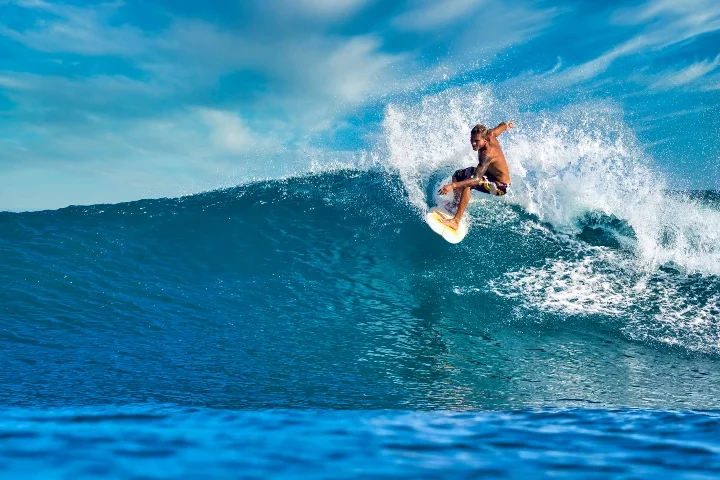
Once standing on the board, we can take advantage of the entire downswing of the wave and its momentum to surf. This way, you have the freedom to control the board and be able to select any option: turn left, turn right, or perform any other type of maneuver. This position requires a lot of training, as well as excellent control of technique and posture on the board.

The 5 steps required to be able to stand up on the surfboard:
Below we will briefly summarize the steps required to get on the board, paddle, and stand up correctly:
- You must be properly positioned on the surfboard. The correct position is centered, knowing where the wave is. Our knees are placed on top of the fins and our feet are slightly outboard, touching the rail of the board.
- When a wave we want to ride is three or four meters behind us, we begin to paddle slowly with our arms, twisting our necks to get into the best position, looking for the peak or highest point.
- As the wave approaches, we increase the intensity of the paddling to match the speed of the wave with that of our board. The paddling should be progressive, increasing as the wave approaches.
- When the wave begins to lift the back of the board, we give a couple of strong strokes and stand up, using the technique for standing up on the board. This is the exact moment to get up.
- Once we’re standing on the board, at the top of the wave, we’ll have the opportunity to choose the best option for riding it. This is the goal for every surfer: to be able to stand up at the top and perform turns, walls, and other maneuvers.








0 Comments