

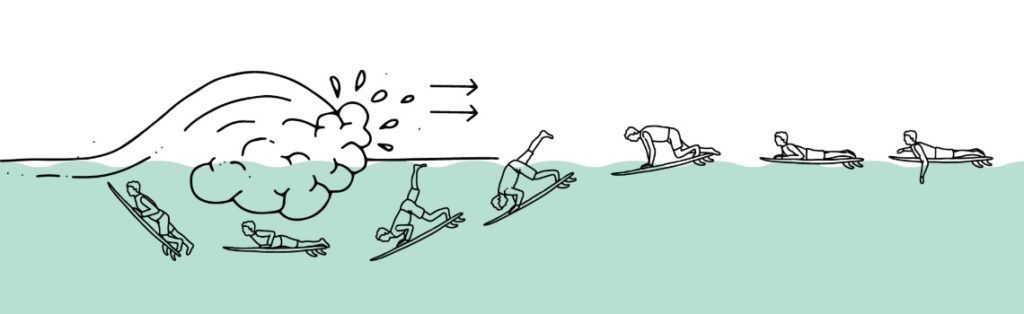
If you want to advance in surfing, there’s one technique you absolutely must master: duck diving. No, we’re not talking about gastronomy, but rather one of the most important moves for reaching the peak without getting tossed around by a wave in the process. Duck diving allows you to dive under the wave with your board and avoid its force before it crashes over you. In this article, we explain step by step how to do it, why it’s so important, and what mistakes you should avoid so you don’t choke on the duck dive… neither on land nor in the water.
What is ducking?
As you might guess, this article isn’t about Chinese food and how to make an exquisite duck à l’orange. In this post, we’re going to talk about one of the most important surfing techniques you must master to reach your peak. Duck Diving, or “Duck Diving,” is a technique for overcoming oncoming waves. It’s not a technique for standing up on the board, nor a paddling technique to reach the wave, but quite the opposite. We’re talking about a method for reaching the area where the waves are breaking.
In short, duck diving is based on diving beneath the wave or foam with your board to avoid its force. It’s a technique that any professional surfer should master (although many of us struggle with it), and it should be taught in intermediate and advanced level courses at any surf school. This is a very difficult technique, which for many is as difficult as performing complex maneuvers, such as a floater, a tube, or a re-entry.
Do the Duck in 3 moves:

1. Approaching the wave
Paddling hard is the advice you should keep in mind. It’s important to have a certain speed before the wave reaches us to be able to ride it. If the wave catches us stationary, it will be impossible to perform the duck maneuver and we will be tossed around. The paddling should be progressive, similar to if we were catching a wave. You should perform a couple of powerful strokes 2 meters before the wave or its foam reaches you. You must keep in mind to leave a safe distance from the wave to continue practicing the technique.

2. Wave entry
Grab the rails of the board, at the top of the board, between chest and shoulder height, depending on the length of your board. It’s important to maintain a firm grip and keep your arms level.
The next step involves stretching your arms and placing one knee or foot on the tail of the board. Kick your other leg upward to generate a powerful downward thrust. At this point, push the nose of the board down into the bottom of the wave with your entire body. If you perform the first step correctly, the board will simultaneously propel itself forward.

3. Wave exit
After a few seconds under the wave, when you notice it has completely passed, the final duck step arrives. We must give a strong push to the tail of the board, either with our knee or our foot. This will rotate the position of the tip and give it an upward direction. The exit from the wave will be fast, due to the momentum of the internal turbulence generated under the waves and the upward force of the board and our body.
We must take into account a series of very important details when doing the duck surf:
- Performing the duck flip depends on the board’s volume. If the board is very large and has a lot of volume, it will be more difficult to sink it and therefore overcome the wave from underneath. Shorter boards, that is, with little volume, make the maneuver easier. Therefore, choosing a surfboard or another depending on the type of waves should be taken into account.
- The technique can be practiced in the sea without waves, in a pool, or even on land. It is therefore recommended to do it before a surfing session.
- When paddling toward the wave, the distance to stop and brake should be around 2 meters. If we continue paddling, we won’t have time to complete the movement. If we stop before, the wave will reach us at a slow speed.
- The wave entry should be at an angle of approximately 45°. If it is too horizontal, the force of the wave will push us, tossing us around and making us spin. If it is too vertical, we will sink, making it twice as difficult to exit the wave. Additionally, in some cases, the tail of the board will remain above the surface of the sea, being hit by the wave.
- The time spent under the wave should be adjusted to the wave’s passage. If we stay under the wave too short, we’ll exit at the very end of the wave. On the other hand, if we stay under the wave too long, we may find the next wave in the series too far ahead.






0 Comments