
At first glance, it might seem like you don’t need a lot of equipment to surf compared to other sports. Surfing is an activity you can practice alone, in direct contact with nature, and in almost any place with a coast. Therefore, we believe that, with just the sea and a surfboard, we have enough elements to carry out this sport.
However, there are several essential surfing elements that make this sport a much more complete and enjoyable activity. If you’re going on a surf trip, you should leave room in your suitcase for a series of surfing accessories that are vitally important for every surfer.
Therefore, at the Biosurfcamp surf school, we’ve prepared this article in which we review all the surfing equipment necessary for this sport. If you’re already determined to ride the waves, take note of all the surfing equipment you’ll need.
Essential materials for surfing
The surfboard

The surfboard is the fundamental instrument for practicing this sport. There are different types of surfboards, each designed for a different type of surfer: foam boards, shortboards, longboards, evolutionary boards, Malibu boards, etc. Therefore, it is vitally important to select the board that best suits our physique, level, type of wave we are going to surf, and the style of surfing we are going to develop. This task is very complicated because sea conditions are very changeable, so many surfers travel with two or three boards, selecting the one they will use each day.
At Biosurfcamp, we have written an article on references for choosing a surfboard, to help you choose the size that best suits your characteristics. When purchasing a board, it is very important to choose the one that best suits you, in order to progress more quickly in your surfing.
At first, it is advisable to use larger, wider, and thicker boards for surfing. This type of board is the one we use in our beginner’s courses in Suances. Large boards, having more volume, require less paddling to catch the wave, and are also easier to stand on (since they don’t sink). On the other hand, and as a general rule, as our surfing progresses, the size of boards decreases (except for longboards). Small, narrow, and thin boards allow for more maneuvers and are designed for people more accustomed to riding waves.
The wetsuit

Just like with surfboards, there are a multitude of wetsuits to choose from. There are numerous wetsuit manufacturers, so it’s important to understand that choosing one can be a bit difficult. The size of the wetsuit doesn’t have to match your usual clothing size (it should fit snugly), so it’s essential to try it on before your surf session.
The main purpose of a wetsuit is to keep you warm in the water. Your choice should be based on the water temperature where you’ll be surfing, as well as your body measurements. It’s common to own several wetsuits depending on the time of year and the location you’ll be surfing. On the Spanish coast, it’s common to divide wetsuits into winter and summer wetsuits.
In winter, people usually opt for a 4/3 or 5/4 full-length wetsuit for those who are more sensitive to the cold. The first number refers to the body thickness in millimeters (chest and back), while the second refers to the thickness of the joints. Occasionally, some surfers wear a 5/4/3 wetsuit, which combines all three sizes to protect from the cold and improve paddling (with 3 mm in certain joints).
In summer, people often opt for a 3/2 or 2/2 wetsuit. These suits are much lighter and can be both long and short. However, in certain locations, it’s common not to wear a wetsuit or to use only a Lycra suit. The Lycra is used to avoid direct contact with the board and prevent chafing. Ultimately, the choice of wetsuit depends on the individual surfer’s preferences.
Wetsuit care is essential. After each swim, it should be cleaned with mild soap and rinsed with fresh water to prevent damage to the seams. In our article on cleaning wetsuits, we give you a series of tips to extend their lifespan.
The lifline or leash
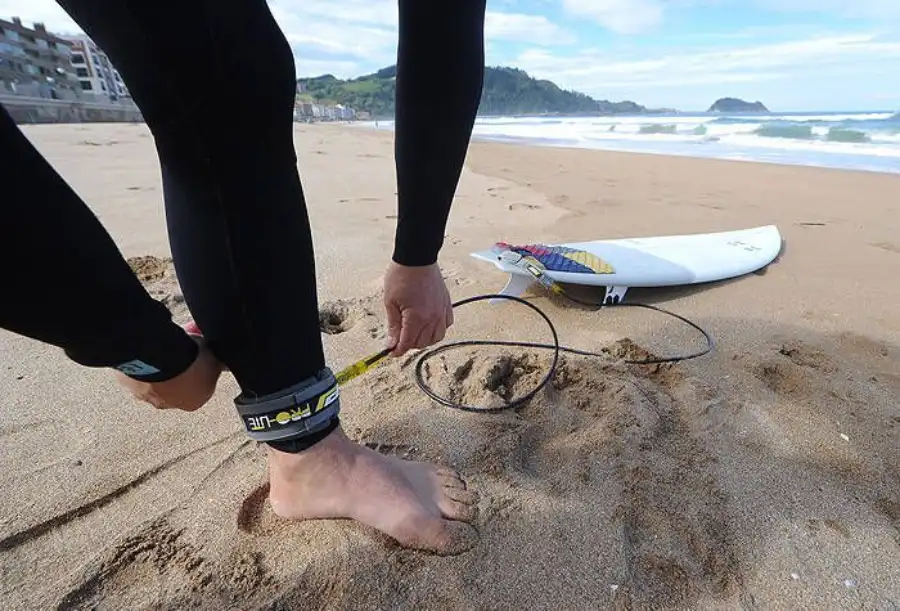
The lifeline, also called a leash, is a rope that connects the board to the surfer’s body. The rope is tied around the back foot (the foot we place on the back of the board when standing up) with a Velcro closure. The rope is usually made of elastic plastic to prevent it from breaking in the event of a fall. We recommend placing the lifeline under the wetsuit, facing away from the board (never toward the other foot), to increase resistance.
The purpose of the lifeline is to always keep the board under control, preventing it from getting lost and/or hitting other surfers. Therefore, it is important to check it often to ensure it is in good condition. It is also advisable to carry several lifelines so that in case of breakage, we can continue surfing.
The leash is usually the same length as the board, although in big waves, longer lifelines are often used for increased safety. Likewise, shorter inventions can be used in small waves, since the power of the sea is not as great and it is easier to keep the board under control.
The fins

Fins are small fins attached to the underside of the board. The purpose of fins is to provide greater maneuverability and grip in the waves. This way, we avoid skidding and make it easier to maneuver on the wave. Fins can be defined as rudders that allow you to make turns and stay stable on the board.
Surfboards can have from one to five fins, depending on the surfing experience. Single-fin boards are usually used for longboards, while 4- and 5-fin boards are used for big waves. The most common configuration consists of three fins, two side fins, and a rearward center fin.
Furthermore, there are different types of fins depending on their shape, profile, height, size, and flex. If you want to know all the details about this essential element for surfing, check out our article on choosing fins for surfing.
Paraffin
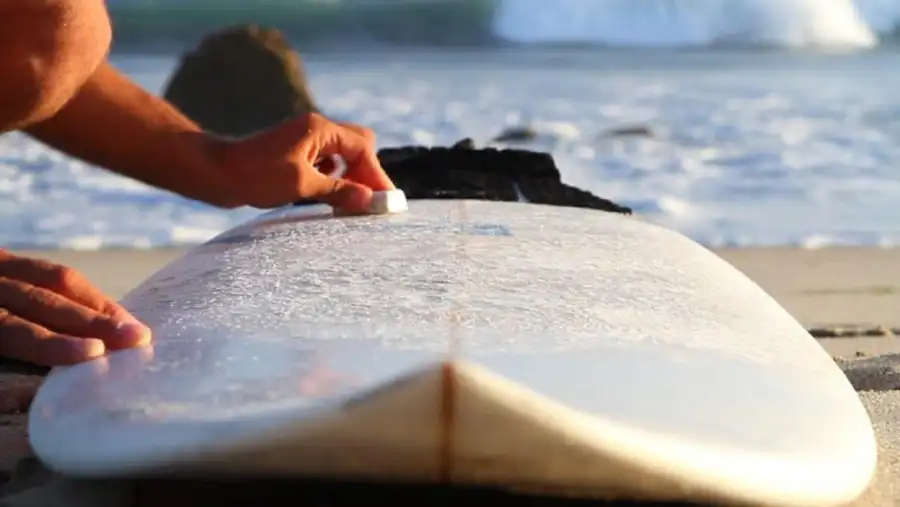
Paraffin is a wax that must be spread over the top of the board every time it is used. Its purpose is to prevent the surface from slipping and make it easier to stand on. The reason for using paraffin is that the finish of surfboards is very hard and slippery, making it difficult to glide through the waves. As a result, standing up and maneuvering on the board becomes very difficult.
In 1930, wax began to be applied to the top of the board to increase grip. This wax has evolved into the different types of paraffin we have today. There are different types of paraffin depending on the water temperature. Winter paraffins are much softer than summer paraffins.
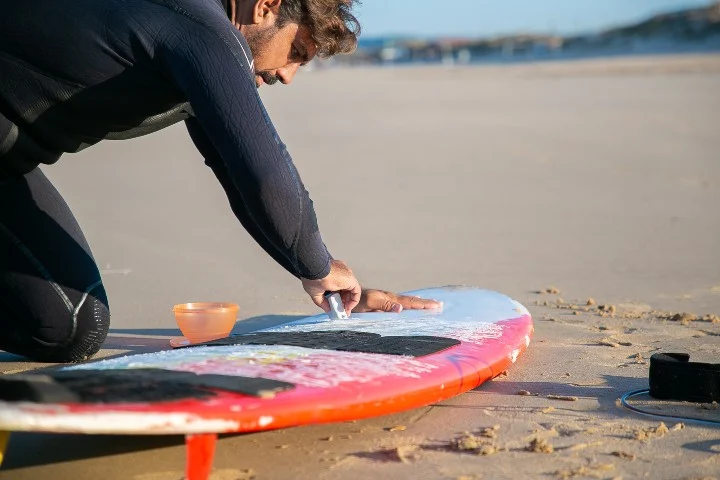
The paraffin is distributed along the areas that come into contact with our feet at some point while surfing. Therefore, depending on the type of board, it is applied in different areas. It’s also common to use a comb to grate the wax and spread it along the board. It’s also important to clean the board before applying wax, as you shouldn’t apply wax over the residue from previous surf sessions.
The grip
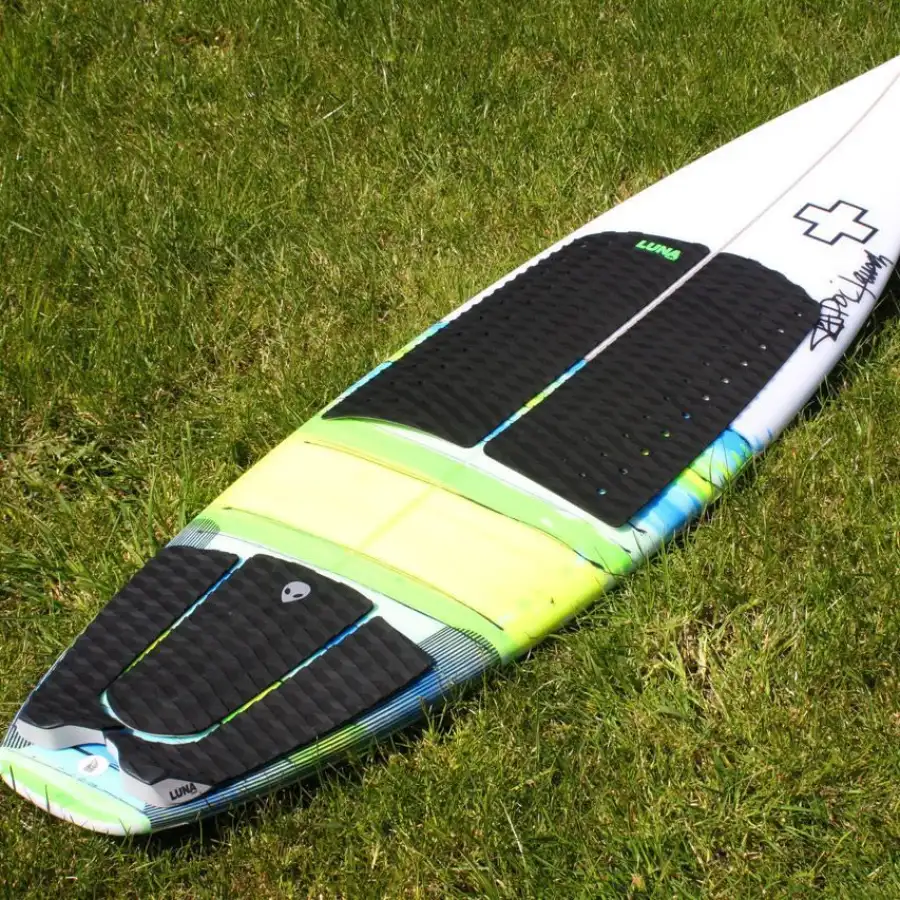
Grip is a wax substitute that performs the same function. It’s a rubber-like material that is glued to the top of the board to prevent slipping when the rider stands on it. The grip should be applied to a clean, dry board and left to sit for 24 hours to adhere.
The most common use of grip is on the tail of the board and combined with wax on the front. This is because the grip heel (the raised area at the end of the grip) stops our back foot. However, it’s becoming more common to see surfers with grip on their entire board.
As we saw in the article “Wax vs. Grip,” both options offer a series of advantages and disadvantages both in and out of the water. The ultimate choice depends on the surfer, and neither is better than the other. It’s best to try both options and see which best suits your tastes.
Other optional surf accessories
Booties, hat and gloves:
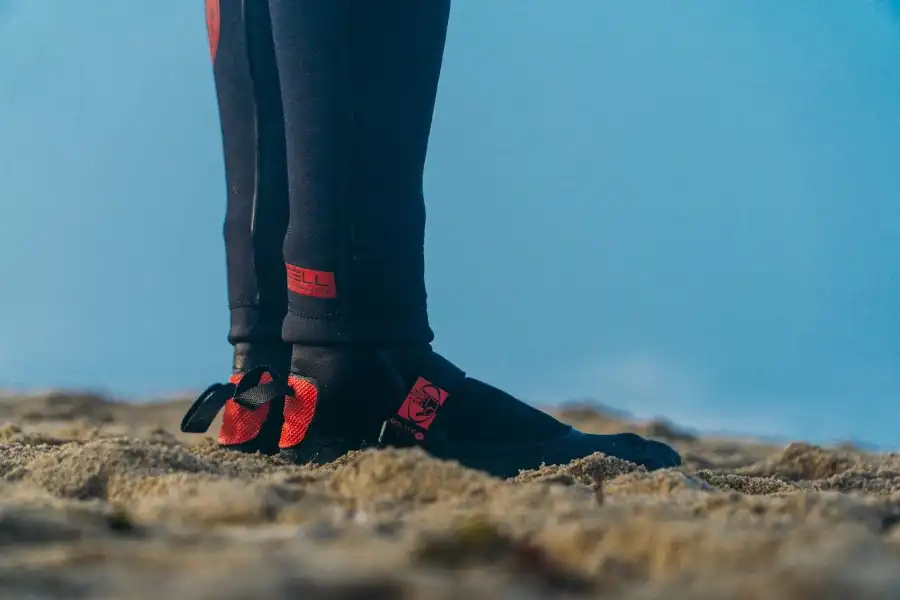
In addition to a wetsuit, it’s common, especially in colder areas and in winter, to wear booties, gloves, and a hat. These items aren’t mandatory in the water, but they’re highly recommended if you want to surf year-round, especially booties.
Booties are tailored to the surfer’s needs and have a hard sole that adheres to the board to prevent slipping. Some surfers find them quite uncomfortable and avoid them, while others say they surf better with them. If you’re going to waves with rocky bottoms, a bootie can be somewhere between important and essential if you don’t want to get stuck in a sea urchin, as in the Canary Islands, or scrape yourself in reef areas.
Board cover
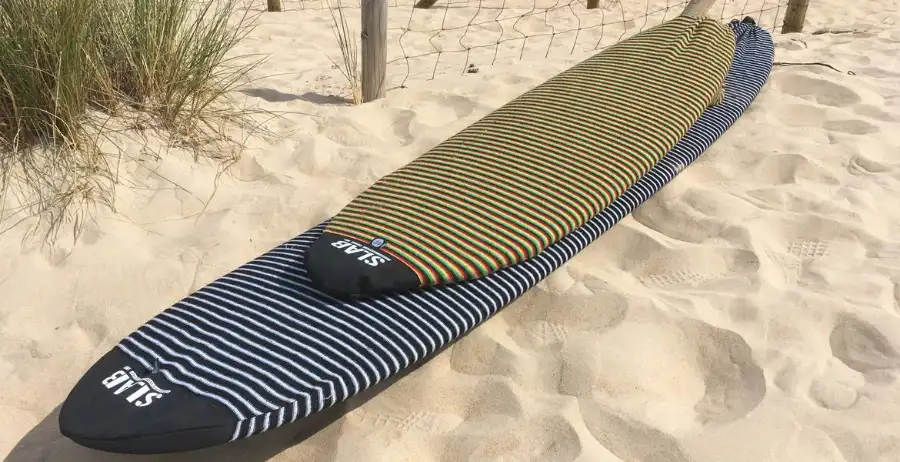
Although optional, it’s highly recommended to store your surfboard in a bag after your session. They’re easy to purchase, as they’re available at any surfing store, regardless of the size of your surfboard. There are several types of bags, depending on what you’re looking for:
There are more basic ones, commonly known as towel bags. These are designed for people who don’t travel much and only have to carry their board from their home to the beach. These bags dry the board completely and prevent prolonged direct sunlight.
On the other hand, there are more professional travel bags. They’re usually padded and shock-resistant, like a suitcase. This way, you can take your board anywhere in the world without any damage. They also usually fit several boards if you remove the fins. You can fit all your luggage in these multi-board bags to save on check-in costs. A great idea if you’re traveling by plane with your surfboards for a surf trip.
Roof rack and/or straps
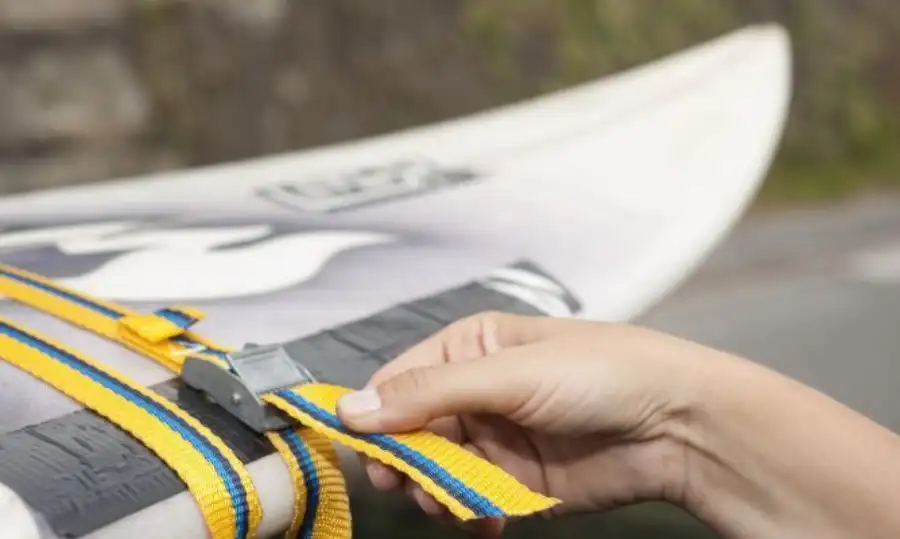
When you have to travel to the beach by car, it’s advisable to use straps and/or a roof rack. Straps are ropes used to secure the board to the top of your car or van, in cases where you can’t carry it inside. These straps are tightened to keep the board from moving while driving.
However, it’s advisable to use a roof rack, especially if you frequent this sport and have to make long trips. A roof rack provides greater stability for the board than straps alone and allows you to fit several boards without them moving..
Paraffin comb
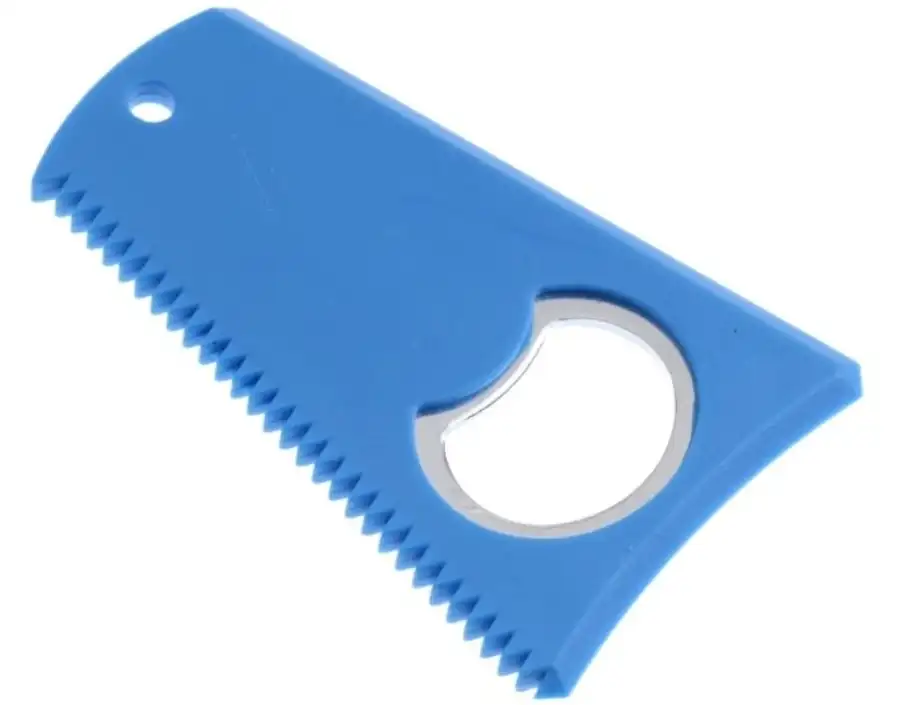
The wax comb is a very useful surf accessory. This tool helps you spread and scrape the wax evenly across the top of your board, preventing any areas from becoming unused or from accumulating.
The comb also helps remove old wax from the board. Wax loses its adherence with each use, so it’s a good idea to clean your board every time you use it. With the comb, you can scrape the surface and remove any unusable wax.
Sun Protection
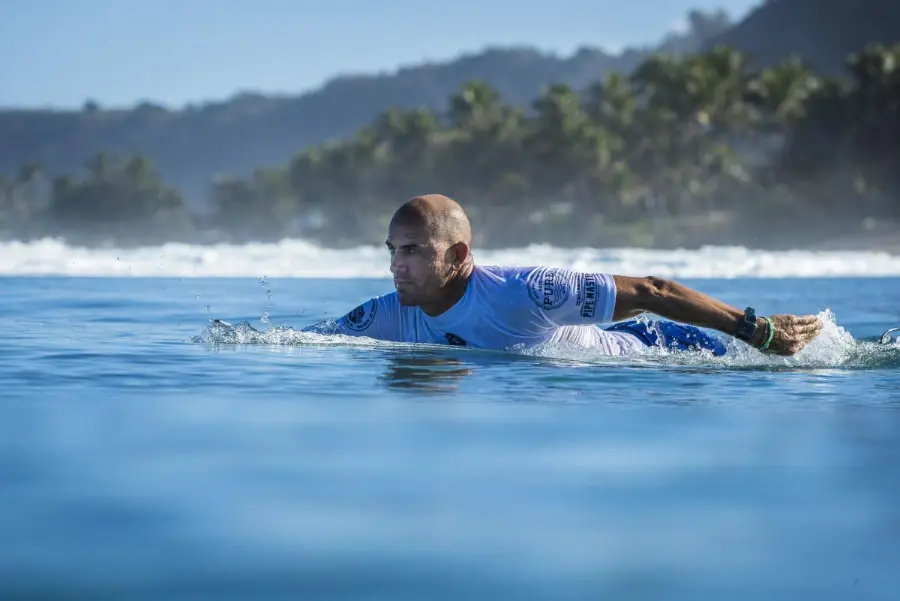
Even though we go into the ocean every day, the use of sunscreen is mandatory for any surfer. Sunscreen should be used especially in warm countries and in summer. The water reflects the sun, so its rays hit us constantly when we’re surfing. Therefore, we should apply sunscreen to our face, especially the forehead and under the eyes, as these are the most sensitive areas.
Wearing a wetsuit is a big trap, since with most of our body covered, we assume we won’t get burned. It’s also important to keep in mind that even when the sun isn’t shining, we can still get burned, and we’re more likely to do so in the water than out. Therefore, it’s advisable to always carry a small bottle of sunscreen. Also, look for a dry sunscreen that won’t mix with the water.











0 Comments