

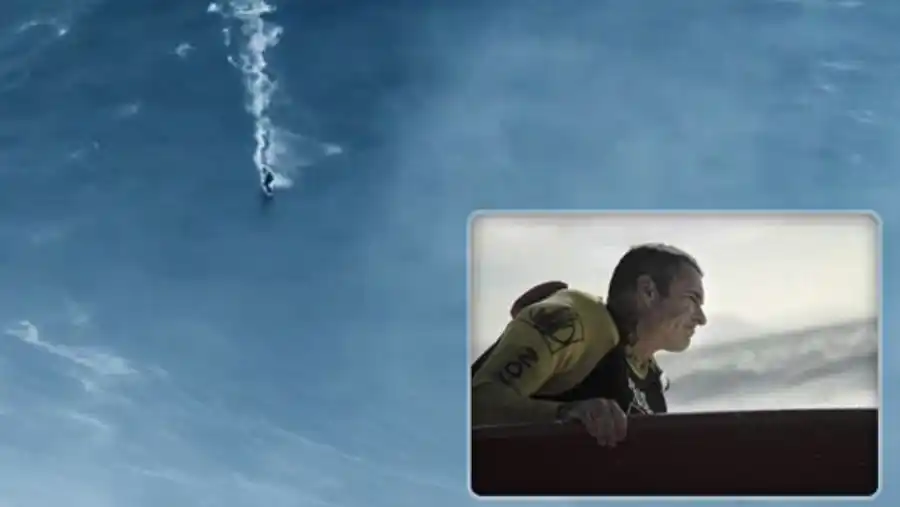
The waves at Nazaré in Portugal are often the largest in the world. These are giant waves that can rarely be caught by paddling alone; usually, a jet ski is needed to tow surfers, helping them reach the speed necessary to ride down. This is common in several of the best surfing spots globally and in big wave locations like Mavericks in California or the giant wave known as La Vaca in Cantabria.
This small Portuguese town, located about 100 kilometers north of Lisbon, has become a key reference point in the surfing world. In front of its towering cliffs breaks the largest wave in the world, which on big swell days can exceed 30 meters (about 100 feet) in height.
The ambition for speed and adrenaline among some skilled and brave surfers has known no bounds since this unique spot was discovered. In 2012, the Guinness World Records Organization confirmed that the 23.7-meter (78-foot) wave surfed by American Garrett McNamara at Nazaré, Portugal, was the largest wave ever surfed at that time. This wave was ridden at Nazaré Beach in November 2011.
That giant wave world record stood for several years until 2017, when Brazilian surfer Rodrigo Koxa rode a 24.38-meter (80-foot) wave at the same Nazaré big wave spot. This daring athlete broke the world record previously held by Garrett McNamara at that very beach.
However, Garrett McNamara himself submitted another video to the organization showing him surfing an even bigger wave at Nazaré—about 100 feet (approximately 30 meters), a true monster. This is expected to become a new Guinness World Record, pending official confirmation from Guinness World Records.
Some of the best big wave surfers gather at Nazaré Beach in Portugal. This beach is famous for amplifying the power and height of the waves, thanks to the Nazaré Canyon—a unique underwater canyon that is 4,300 meters deep and 210 kilometers long, ending right at the coast.
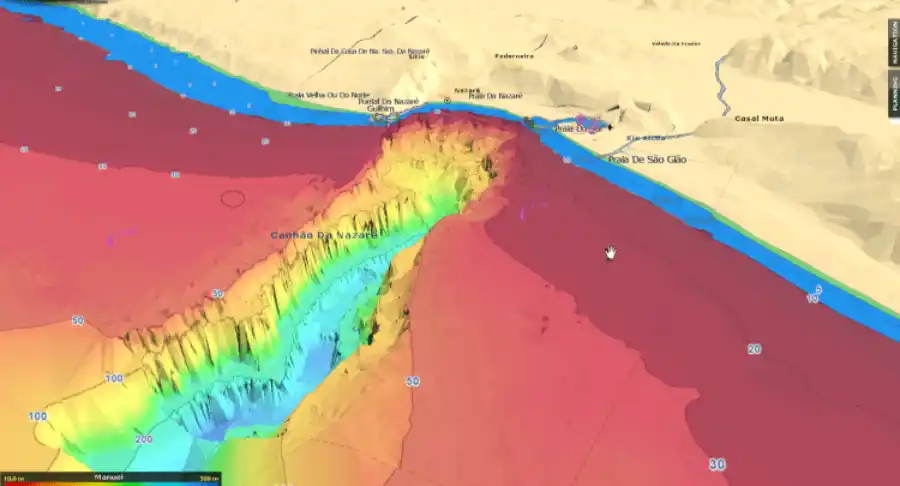
This underwater canyon causes significant changes in the depth of the seabed, creating an effect that results in the largest waves in the world. The incoming swell drops abruptly into the great Nazaré Canyon, causing the wave to compress and grow disproportionately.
Additionally, it’s important to note that the current at the beach flows in the same direction as the waves, further contributing to their growth. This happens because the returning wave from the coast joins with the breaking wave itself, increasing its size and water mass by several meters.
Finally, it’s worth emphasizing that the best wind for producing the biggest waves at Nazaré is WNW—that is, wind coming from between the west and northwest.
Forecasting giant waves at Nazaré: The swell
One of the most challenging things to predict is when a great big wave session will arrive. Surfers consult the most popular maritime forecast sites, checking the wave forecasts for Nazaré. One key factor to watch when searching for giant waves like those at Nazaré is the swell.
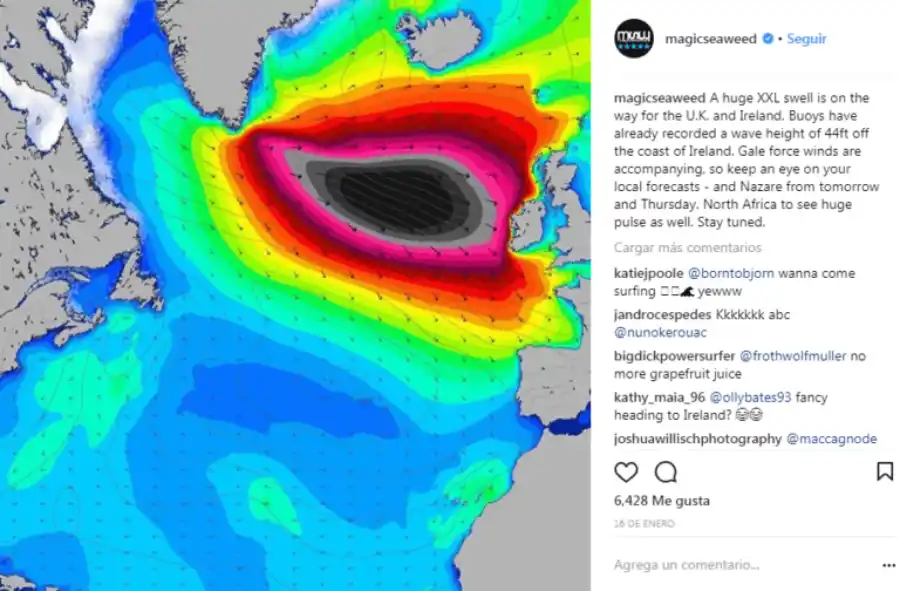
The swell refers to the deep ocean swell that reaches a coast. Changes in wave patterns caused by atmospheric conditions generate waves that travel hundreds of kilometers before breaking on a beach. When the swell is strong, the size of those waves increases noticeably. A clear example was the extraordinary swell forecast in January 2018, when a powerful swell stretched from Ireland all the way to the Iberian Peninsula—an unprecedented swell prediction.
At the beginning of 2018, several of the bravest surfers gathered, including Garrett himself and his friend Hugo Vau. Hugo Vau is one of the most renowned surfers on the international scene, and during a session in early 2018, he surfed the wave known as “Big Mama” off the coast of Portugal—an enormous wave that could have exceeded 30 meters (98 feet) in height. In the video, it is barely possible to make out Hugo Vau surfing due to the vastness of the Nazaré waves and the tons of saltwater surrounding him. Additionally, it is very difficult to measure the size of that wave, but if confirmed and a clearer video is obtained, it could be as high as 35 meters (about 115 feet)—taller than a 10-story building.
Why can’t we talk about a new Guinness World Record? Measuring the waves at Nazaré
Apparently, measuring the height of a wave of this size isn’t that easy. In fact, an exact method has yet to be found, and there are several ways to do it, as we explained in our article “How to Measure Waves.” The most scientific and accurate method currently available was developed by Willard Bascom Newell. However, it’s not easy to apply because it essentially compares the wave’s crest to the sea level if there were no waves. In other words, it measures from the crest down to its base.
Practically all measurements rely on graphic methods since it’s impossible to go around with a tape measure and ask the wave to stay still. Therefore, it’s very important to consider the position from which the measurement was taken. For example, the Nazaré wave is measured from the cliff near the beach. As one of surfing’s most famous sayings from the exceptional Buzzy Trent goes, waves aren’t measured in feet and inches — they’re measured in increments of fear.
Our surf school in Suances offers surf courses at Los Locos Beach and La Concha Beach. Here you can get your first contact with the sport and gradually work your way up to surfing spectacular places like Nazaré.







0 Comments