


Although Hawaii is considered the birthplace of surf, it is actually difficult to determine the exact origin of this sport, as there are no written documents to confirm it. Being a very ancient sport, it is hard to pinpoint an exact date, especially since European travelers were the first to describe it without knowing how much prior development it might have had.
With the emergence of modern surf and its worldwide spread, the contemporary history of the sport has been reconstructed, along with a brief look into its past. Today, surf is practiced almost all over the world, with the most developed industries in Australia, Europe (especially Spain and France), and the United States. However, at Biosurfcamp we want to offer this article to try to uncover the origins and history of surf.
Before surf: Peru and Bolivia, 16th century
To begin discussing the origins of surf, we must move to the “America of Surf.” The caballito de totora is a type of small boat, built with reeds and leaves, used for fishing in Peru and Bolivia. But beyond fishing, it was also used to slide over the waves in a way similar to surfing. It is in the 16th century when this activity is first mentioned, and we could talk about the origin of surf history—or at least a proto-surf.
The Spanish anthropologist and Jesuit Friar José de Acosta was the first to write about the history and customs of the indigenous people of Peru, describing this unique activity on the so-called caballitos de totora by comparing it to “Neptunes cutting through the waves of the sea.” This Spanish monk documented his research in the famous book Natural and Moral History of the Indies, published at the end of the 16th century.
Origins and history of surf: Hawaii, 18th century
In the 18th century, nearly 200 years after the writings about the caballitos de totora, a crew led by the British navigator James Cook wrote about the art of sliding on water that they had observed on some tropical islands. James Cook, who would go down in history as the discoverer of the Hawaiian Islands, spent some time there with his crew, learning about the lifestyle and customs of the indigenous people. The captain died after a conflict with the locals, and command of the expedition passed to his lieutenant, Mr. James King.
In Hawaiian, the sport was called he’enalu, meaning sliding on the waves. The indigenous leader of the island, called the kahuna, had the best board made from the wood of the finest tree. The best beaches on the island were reserved for the nobility, while lower classes were forbidden to surf. Therefore, it was a sport of prestige, reserved for the upper class.
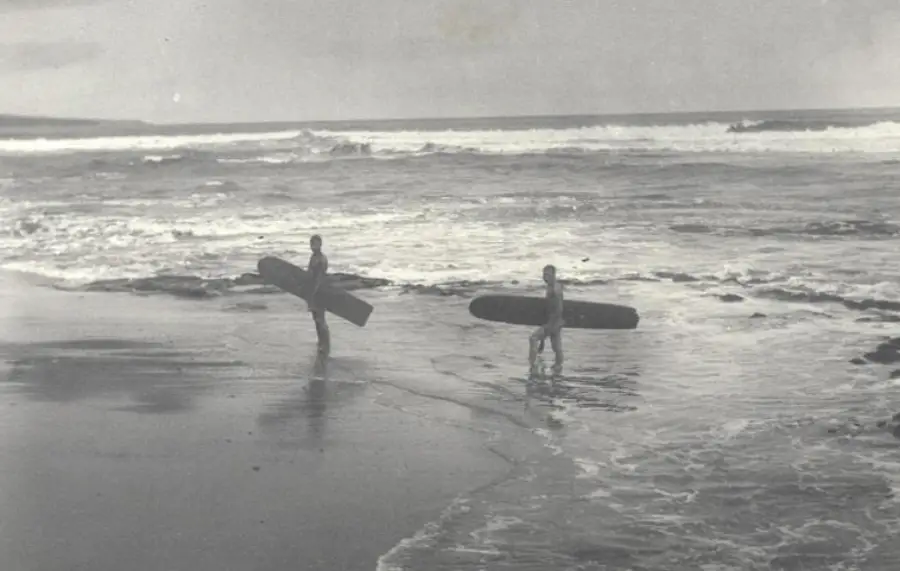
Although the earliest traces of surfing as we know it today were found in Hawaii, it is believed that Hawaiians were not the original creators. Most of the inhabitants arrived in Hawaii from other islands in the Pacific Ocean, mainly Polynesia. It is thought that surfing as we understand it began here. However, surfers of that era rode the waves lying down. It is also assumed that surfing was originally a method to bring fish to shore more quickly, not just for fun.
Decline of Surfing: 19th and 20th Centuries
From the year 1800 onwards, with the arrival of Christian missionaries to the island, surfing—like many other traditions—was banned in Hawaii for being considered immoral. During this period, Hawaiian culture began to disappear due to the arrival of foreign populations. The extinction of the Hawaiian way of life was caused by the imposition of European culture, the many diseases brought by ships to the islands, and the prohibition of indigenous customs.
For the next 150 years, Christian missionaries almost completely eradicated this sport. During this time, the strict culture of the Calvinist monks who inhabited the island was based on religion, work, and modesty, leaving no room for recreational or sporting activities like surfing.
An important fact to note during this population decline is that the indigenous people made up only about 30% of Hawaii’s total population. At this point, surfing was practiced only by a few brave individuals.
Surf’s Revival: 20th Century

It was at the beginning of the 20th century when the tradition of riding waves on wooden boards was revived on the beaches of Hawaii. This revival was led by a group of descendants of former Hawaiian kings who sought to reclaim their customs. Among them stood out Duke Kahanamoku, considered the father of modern surfing.
Throughout the 1920s, Duke was an Olympic swimmer, founder of the first surf club on the Hawaiian beach of Waikiki, and gave numerous talks and demonstrations that helped popularize the sport in Europe, Australia, and the United States. During his travels around the world, he organized surfing events that became the main catalyst for the sport’s widespread growth.
In the 1930s, this sport began to gain popularity in California. Along the California coast, major surfing championships were held, and the first surf sports magazines were created. During those years, many improvements were made to surfboards, including the addition of a surf fin to the bottom of the board by Tom Blake. The fin made it possible to perform turns and maneuvers while riding the wave, becoming one of the main surf equipment additions to the sport alongside the wetsuit.
Between 1939 and 1945, due to World War II, there was a significant pause in the practice of surfing. However, this period allowed many sailors stationed in the Pacific to discover the sport, and new materials developed during the war were later used in surfing. After the war ended, surfing experienced exponential growth worldwide.
In the 1960s, a musical and cinematic culture emerged around surfing, with movies like Gidget and bands like The Beach Boys spreading surf culture throughout California and the rest of the world. This was the golden era of surfing, marked by the development of shorter boards, the use of new materials in board manufacturing, and the establishment of a surf culture that remains strong today. Additionally, longboards were created in the early ’60s, ideal for performing tricks.
In the 1970s, surfing began to gain popularity in Europe, and the first wetsuit was developed. At the same time, surfers started using twin fins, allowing for sharper turns and more complex maneuvers. This decade also marked the beginning of major world competitions, the rise of internationally renowned surfers, and continuous growth of the sport up to the present day.
This surfing renaissance took place mainly in three key locations: Hawaii, Australia, and California. These places remain the primary reference points for the modern history of surfing.









0 Comments