


Did you know that fins are a fundamental element to get the most out of our surf? Some experts claim that the performance of the surfboard can improve by almost 40%, and others attest that it would be practically impossible to surf certain waves without fins. For this reason, fins have become a necessary piece for all surfers, although in many cases they remain unknown.
Surfboard fins: choosing the best fin combination for your board
To choose the most appropriate fins for each surfer, we first need to understand their main characteristics. That’s why we have prepared this article answering the question: How to choose the fins for a surfboard?
What are surfboard fins for?
First things first, let’s talk about fins. Fins on a surfboard are one of the essential surfing materials for practicing the sport. Often, not only inexperienced surfers are unaware of the fins’ function, but many intermediate and even experienced surfers don’t fully understand their purpose. Starting from the beginning, the first thing to know is that fins are appendages placed on the underside of the surfboard.
Fins come in different materials and shapes and have two fundamental functions. On one hand, fins provide greater maneuverability to the board, allowing us to ride the face of the wave and perform maneuvers on it. On the other hand, fins serve a gripping function, preventing us from sliding out on the wave. This is because they cut through the water, creating greater stability in movements.
To get an idea of what surfing without fins would be like, imagine a car without a steering wheel or pedals. A board without fins barely has any direction and slips on the wave, making maneuvers impossible. In the end, it’s easier to surf without waves than to surf without fins.
Main characteristics of fins
Shape (Template)
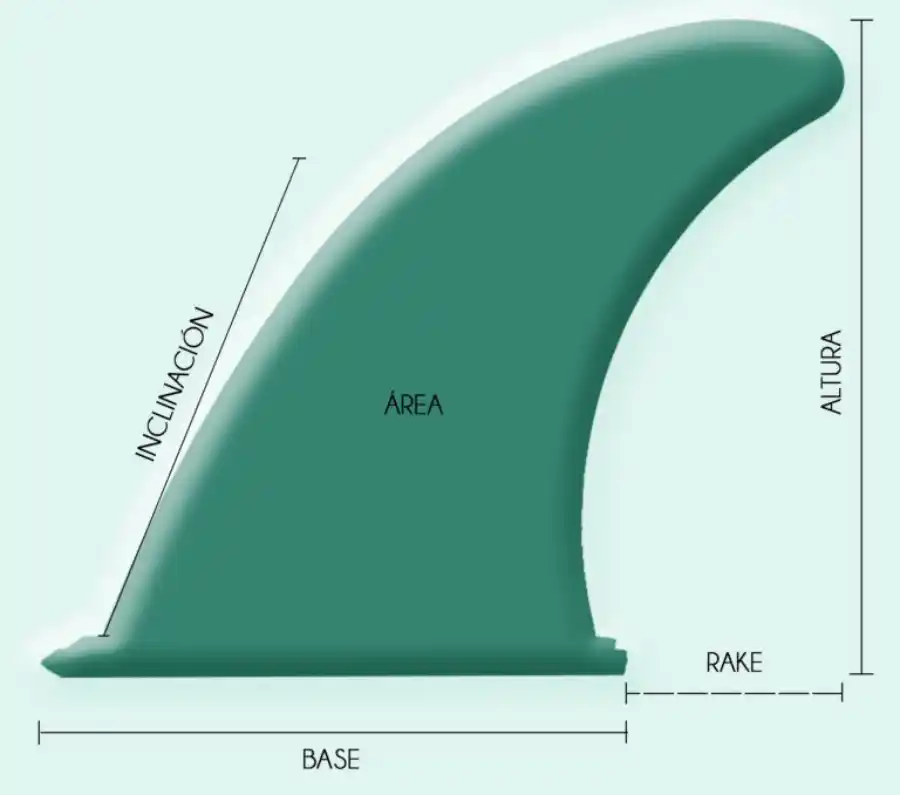
The shape is the most visible parameter when choosing surf fins and is defined by the area, the tilt, the height, and the base width.
On one hand, the tilt is determined by the angle and the rake, which refers to how far the tip of the fin extends beyond the base’s end. The tilt affects the turn radius — the straighter the fin, the tighter the turns will be.
On the other hand, when we talk about the base of the fin, we should know that a wider base provides more power, while a narrower base offers greater maneuverability.
Regarding the height, the longer the fin, the harder it is to lift it out of the water, so it will have better grip. If it’s short, it will be easier to slide out.
The size of the surf fin can be determined by the surfer’s weight, with the relationship as follows:
| Fin Size | Surfer Weight |
| XS | Less than 55 kg |
| S | 55 – 70 kg |
| M | 65 – 80 kg |
| L | 75 – 90 kg |
| XL | More than 85 kg |
As you can see, the weight ranges overlap. This is because the fin size doesn’t depend solely on weight, but also on all the parameters mentioned above. Therefore, depending on your surfing level and style, you will choose one fin size or another.
The profile of the fins (Foil)
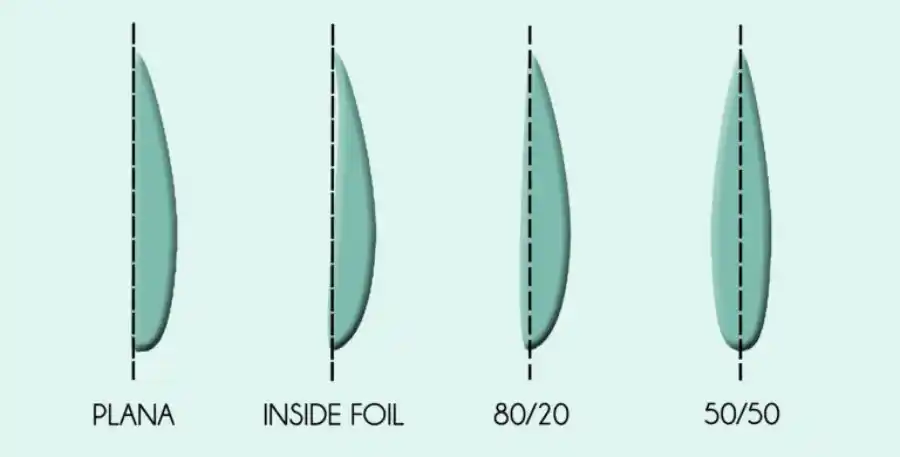
The profile of the fins refers to the shape of the fin’s cross-section, especially the inner face of the side fins. There are four types: flat, inside foil, 80/20, and 50/50. The difference in the inner face affects the speed at which water flows along each side, producing different effects:
- Flat profile: The inner face is flat and the outer face convex, providing fairly balanced turning and grip capabilities, resulting in a secure and controlled feeling on the board.
- Inside foil: The inner face is concave and the outer face convex, which increases water flow, boosts thrust, and reduces drag, resulting in a faster fin that accelerates more easily. It offers less control than the flat profile.
- 80/20: Usually used as the rear fin.
- 50/50: Both sides are convex. Water flows equally on both sides, offering security and control. It’s typically used as the center fin.
Flexibility of Fins and Material
The flexibility of the fins depends on their shape and the material from which they are made. The more rake a fin has, the more flexible it will be. The material also affects flexibility. This flexibility determines how much the fin will propel the board. More flexible fins are usually used on softboards.
Another important characteristic of surf fins is the material. There are carbon fiber fins, which tend to be stiffer and more stable than those made of plastic.
Number of Fins According to Wave Size and Type
Choosing the number of fins is one of the most important decisions when surfing, and it depends on the type of wave and what you want to do in the water.
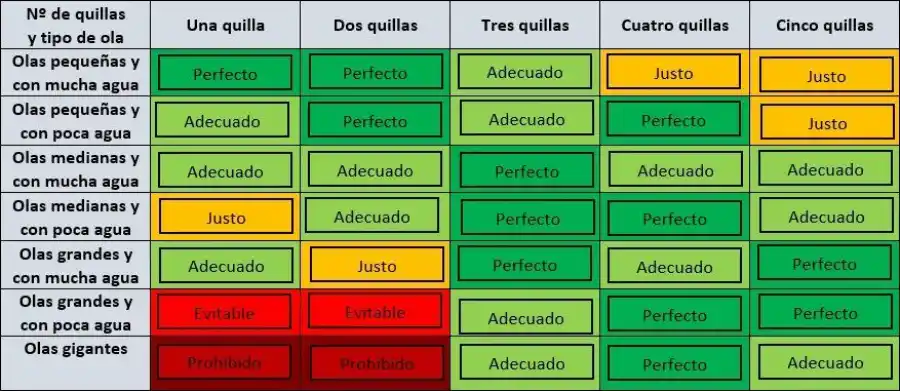
- Single fin boards: Allow for shorter turns but provide greater speed and stability on the optimal wave line. This is the most traditional surf setup and is often used on some longboards for tricks.
- Twin fin boards: Used on shortboards to generate grip, maneuverability, and speed. This setup gives a control feel similar to skateboarding, allowing for wider and longer turns.
- Thruster setup (3 fins): The most common setup today. Perfect for all wave types, offering speed and stability. Typically features one rear center fin and two slightly forward side fins, allowing maneuvering to both sides. This setup can be easily changed to twin or single fin configurations. This is the setup used at Biosurfcamp for our surf courses.
- Four and five fin boards: Designed for bigger waves as they provide more grip and require fewer turns. Five-fin boards allow all the above configurations due to their flexible arrangement.
Below is a brief explanatory table to know which fin setup suits each case best.
Fixed Fins vs Removable Fins
When selecting fins for a surfboard, we must consider this property. Fixed fins are attached directly to the board and cannot be removed. This type offers less friction and smoother performance on the wave. Additionally, you don’t have to spend time installing or removing them. However, this setup doesn’t allow for any variation, so you won’t be able to choose different fins depending on sea conditions. Also, fixed fins can sometimes make transporting the board in a vehicle more difficult because they take up more space.
On the other hand, removable fins allow for easier transport of the board in your vehicle and enable you to select the best fins for the current sea conditions. Moreover, if a fin breaks or deteriorates, replacement is quick and easy, letting you get back in the water in just a few minutes.
Fin Selection According to Board Size
- Shortboards: The choice of fins depends on the surfer and their goals. The most common setup is three fins—two on the sides and one in the center. However, you can also use two fins on each side or just one fin on each side without a center fin.
- Longboards: First, you should consider what kind of surfing you want to do. For classic surfing, where the feel of the movement matters more than tricks, the best choice is a large fin with a wide base and rounded shape (e.g., Model D or Dolphin). If you want to perform more maneuvers, opt for slimmer fins with a smaller base, as they allow for quicker, sharper turns.
Additionally, other factors matter, such as the type of waves and sea floor you’ll be surfing over and the type of board you use, as all influence fin choice. For strong waves, rigid fins provide better stability. Flexible fins are more dynamic and propel the board more, but you lose firmness.
As you can see, choosing fins isn’t something to take lightly. Many characteristics must be considered. If you’re unsure, feel free to leave a comment, and we’ll recommend the best fins for you.






0 Comments